Introduction
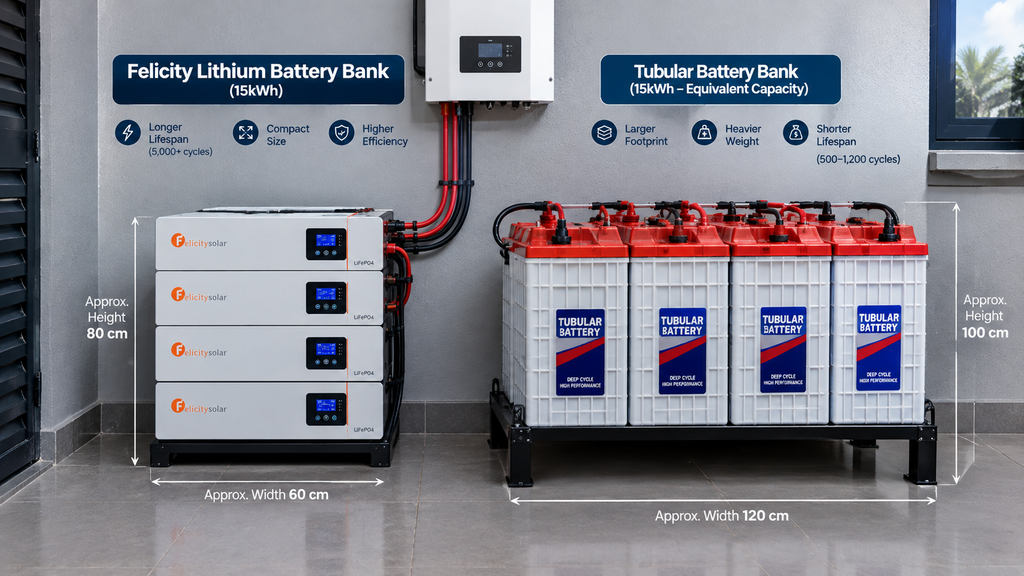
Lithium batteries (left) are typically more compact than tubular batteries (right) of comparable usable capacity. Of every decision in a solar system, the battery is the one where “just buy the cheapest option” tends to backfire hardest and it’s also the decision where the cheapest option isn’t automatically the wrong one either. Lithium and tubular batteries solve the same basic problem (storing solar power for use when the sun isn’t shining) in genuinely different ways, with different price points, different lifespans, and different day-to-day behaviour.
We sell and install both battery types at DD Building Tech, and this guide is built around actual current pricing from our stock, not vague generalizations so you can see exactly what the trade-off costs in real naira, not just in theory.
The Core Difference: Chemistry, Not Just Marketing
Lithium batteries used in Nigerian solar systems are almost always LiFePO4 (Lithium Iron Phosphate), a specific lithium chemistry chosen for solar applications because it’s more thermally stable and safer than the lithium-ion chemistry used in phones and laptops, while still offering the fast charging and deep-cycle durability lithium is known for.
Tubular batteries are a type of lead-acid battery, built with tall, tube-shaped positive plates that give them better cycling durability than a standard flat-plate lead-acid battery. They’re the evolution of the traditional car-battery-style lead-acid technology that’s been used in Nigerian inverter systems for decades, refined specifically for the repeated deep discharge and recharge cycles solar backup requires.
This isn’t a case of one being a “premium version” of the other; they’re fundamentally different technologies with different physics governing how they age, how much they can be discharged safely, and how long they last.
Real Prices: What Lithium and Tubular Actually Cost Right Now
Here’s current stock and pricing across our battery range, so you can see the actual gap rather than a rough estimate:
| Battery | Type | Capacity | Price (₦) |
|---|---|---|---|
| 5kWh 100Ah 51V Felicity Lithium | Lithium (LiFePO4) | 5kWh | 1,070,000 |
| 5kWh 100Ah 51V Taico Lithium | Lithium (LiFePO4) | 5kWh | 1,050,000 |
| 5kWh SMS Lithium | Lithium (LiFePO4) | 5kWh | 1,200,000 |
| 200Ah Lithium Battery | Lithium (LiFePO4) | ~10kWh | 270,000 |
| 10kWh Lithium Taico | Lithium (LiFePO4) | 10kWh | 1,850,000 |
| 15kWh Lithium SMS | Lithium (LiFePO4) | 15kWh | 1,950,000 |
| 15kWh Lithium DD Tech AI | Lithium (LiFePO4) | 15kWh | 1,950,000 |
| 240Ah 12V Tubular Battery | Tubular (lead-acid) | ~2.9kWh | 260,000 |
| 220Ah 12V Tubular Battery | Tubular (lead-acid) | ~2.6kWh | 260,000 |
| 100Ah 12V Gel Sunfit Battery | Gel (lead-acid) | ~1.2kWh | 150,000 |
| 200Ah 12V Gel Pattern Battery | Gel (lead-acid) | ~2.4kWh | 340,000 |
| 12V 100Ah Blue Power Battery | Lead-acid | ~1.2kWh | 280,000 |
Prices reflect current DD Building Tech stock and are subject to change with exchange rate movement confirm today’s pricing on WhatsApp before budgeting.
The pattern here is immediately visible: on a pure upfront-cost-per-kWh basis, tubular and gel batteries look considerably cheaper than lithium. A 5kWh Felicity lithium battery costs roughly 1,070,000 naira, while getting a comparable ~5kWh from tubular batteries (using two 220Ah 12V units in series for a 24V ~5.3kWh bank, for example) costs closer to 520,000 naira less than half the price. If the story stopped there, tubular would be the obvious answer for everyone. It doesn’t stop there, which is the entire point of this guide.
Why Lithium Costs More and What You’re Actually Paying For
Depth of discharge. This is the single biggest practical difference between the two chemistries. Tubular and gel (lead-acid) batteries should generally only be discharged to around 50% of their rated capacity to preserve their lifespan, discharge them further regularly, and you shorten their usable life dramatically. Lithium batteries can typically be safely discharged to 80-90% of their rated capacity without meaningfully accelerating degradation. This means a “5kWh” lithium battery gives you meaningfully closer to 5kWh of usable daily capacity, while a “5kWh-equivalent” tubular bank effectively gives you closer to 2.5kWh of capacity you can safely use night after night without shortening its life.
Cycle life. A cycle is one full discharge-and-recharge. Quality lithium (LiFePO4) batteries are commonly rated for 3,000-6,000+ cycles before their capacity degrades meaningfully. Tubular batteries are typically rated for 500-1,200 cycles under similar usage patterns. For a solar system cycling daily, that’s the difference between a battery lasting roughly 8-15+ years versus roughly 1.5-3 years before real capacity loss sets in.
Weight and footprint. Lithium batteries pack significantly more usable energy into a smaller, lighter unit, a real practical consideration if your battery room or cabinet space is limited.
Charging speed and efficiency. Lithium batteries generally accept charge faster and more efficiently than lead-acid chemistries, meaning less of your solar generation is lost to charging inefficiency, a small but real difference in your system’s overall daily performance.
The Real Comparison: Cost Per Year, Not Just Cost Upfront
This is where the “tubular is cheaper” argument needs a second look. Because tubular batteries need replacing far more often under daily solar cycling, the honest comparison isn’t the upfront price, it’s the cost per year of actual service.
Take a realistic example: a 240Ah 12V Tubular Battery at ₦260,000, cycled daily as part of a home solar system, might realistically need replacement every 2-3 years under regular deep-cycle use. Over a 10-year period, that could mean purchasing the same battery 3-4 times pushing total cost toward ₦780,000-₦1,040,000 across that decade, not counting the labour and disruption of multiple replacements.
A comparable 5kWh lithium battery at roughly ₦1,050,000-₦1,200,000, cycled the same way, could realistically still be performing well after that same 10-year period without needing replacement at all meaning the “more expensive” lithium option can end up costing roughly the same or genuinely less over a decade, while also giving you more usable capacity throughout that entire period (thanks to that deeper safe discharge range) and without the hassle of multiple replacement purchases and installation visits.
This is the calculation that matters more than the number on the price tag on day one, and it’s the conversation we have with every customer weighing this decision.
When Tubular Genuinely Makes More Sense
None of this means tubular is a bad choice, it means it’s the right choice in specific situations rather than the default for everyone.
Choose tubular or gel if: your upfront budget is the hard constraint and you genuinely cannot stretch to lithium pricing right now, your system is used lightly or intermittently rather than cycled hard every single day, you’re building a small backup system as a stopgap rather than a long-term primary power solution, or you’re comfortable with more frequent maintenance and eventual replacement in exchange for lower initial cost.
Choose lithium if: you’re running your system daily as your primary or near-primary power source, you want to minimize the total cost and hassle over a 10+ year ownership period, your battery space is limited and you need more capacity in a smaller footprint, or you simply want to make one purchase and not think about battery replacement again for a decade.
A Note on Gel Batteries Specifically
Gel batteries occupy a middle ground worth mentioning separately from standard tubular. They’re sealed and maintenance-free, unlike some lead-acid types that need periodic water top-ups, which makes them a sensible choice where the battery bank sits somewhere inconvenient to access regularly. They share tubular’s general lifespan and depth-of-discharge limitations, so the cost-per-year logic above applies to gel just as much as to standard tubular batteries. Looking at our current stock, the 100Ah 12V Gel Sunfit Battery and 200Ah 12V Gel Pattern Battery both sit in a similar price bracket to comparable tubular capacity, so the choice between gel and tubular tends to come down to installation location and maintenance preference rather than a meaningful cost or performance gap between the two lead-acid variants themselves.
What About Brand Differences Within Lithium?
Within our lithium range, you’ll notice Felicity, Taico, SMS, and DD Tech AI branded options at broadly similar price points for equivalent capacity. The underlying LiFePO4 chemistry is fundamentally similar across reputable brands; the differences tend to show up in the battery management system (BMS) quality, which governs how well the battery protects itself from overcharging, overheating, and imbalanced cells over its lifetime. All the lithium brands we stock come from suppliers we’ve vetted for genuine cells and functioning BMS protection, which matters more for long-term reliability than the brand name printed on the casing.
How Installation and Wiring Differ Between the Two
It’s worth knowing that switching from tubular to lithium isn’t always a simple drop-in replacement, even when the voltage matches. Lithium batteries typically require a Battery Management System-aware charge controller and inverter setup to communicate charging parameters correctly, charging a lithium bank exactly like a lead-acid bank can undercharge it or, in poorly configured systems, stress the cells unnecessarily. This is one of the reasons we always check inverter and charge controller compatibility as part of any lithium installation or upgrade, rather than simply swapping the battery and assuming everything else in the system will adapt automatically.
Tubular and gel batteries are generally more forgiving of a wider range of charge controller settings, which is part of why they’ve remained a dependable, low-fuss option in the Nigerian market for so long there’s less that can be configured incorrectly. This forgiveness is genuinely valuable for smaller, simpler systems where a customer wants to minimize the number of components that need to be professionally matched and configured correctly, even if it means accepting the shorter lifespan trade-off discussed above.
How This Fits Into Your Full Solar System
Battery choice doesn’t happen in isolation; it needs to be sized alongside your inverter and panel array to actually work as intended. If you’re planning a complete system rather than just a battery swap, our guide on the complete cost of a 5KVA solar system in Nigeria shows exactly how battery choice affects total system cost with real worked examples using both lithium and tubular options.
You’ll also want the right charge controller for whichever battery chemistry you choose; our Solar Charge Controllers page covers MPPT options suited to lithium’s faster charge acceptance. And if you haven’t settled on panel type yet either, our comparison of monocrystalline vs polycrystalline solar panels covers that side of your system design in the same detail as this page.
Not sure which battery fits your budget and usage pattern? Chat with DD Building Tech on WhatsApp and we’ll help you work out real cost-per-year, not just the upfront price tag.
Safety Considerations Worth Knowing About
Lithium’s reputation took a hit in the public imagination from unrelated incidents involving different lithium chemistries, the kind used in some consumer electronics and lower-quality e-bike batteries, which use lithium-ion chemistry that is genuinely more prone to thermal runaway under fault conditions. LiFePO4, the chemistry used in the solar batteries we sell, is a meaningfully different and more thermally stable lithium chemistry, specifically favoured in solar and stationary storage applications because it doesn’t share those failure characteristics. It’s worth understanding this distinction, since “lithium battery” as a phrase covers chemistries with genuinely different safety profiles, and LiFePO4’s track record in solar installations globally has been strong specifically because of this chemistry choice.
Tubular and gel lead-acid batteries carry their own, different set of handling considerations; they contain acid or gel electrolyte and can off-gas slightly during charging, which is why proper ventilation in the battery installation area matters. Both chemistries are safe when installed and used correctly by a qualified installer; the practical difference is more about what precautions matter for each rather than one being inherently riskier than the other.
The Environmental and Practical End-of-Life Question
An often-overlooked part of this comparison is what happens when a battery finally does reach the end of its useful life. Lead-acid batteries, including tubular and gel types, have a long-established recycling infrastructure, the lead content is valuable and widely recycled, and most suppliers (DD Building Tech included) can facilitate proper disposal or trade-in of old lead-acid batteries. Lithium battery recycling infrastructure is comparatively newer and less universally established in Nigeria specifically, though this is improving as lithium adoption grows. If end-of-life disposal is a genuine concern for your decision, it’s a reasonable factor to raise directly with your supplier and ask how they handle old batteries, whichever chemistry you choose.
Making the Decision Practically, Not Just Theoretically
If you’ve read this far and are still genuinely torn, here’s a simplified way to think about it: calculate your available upfront budget first, and then ask whether stretching to lithium is possible even with a slightly smaller initial system (fewer panels, a smaller battery bank) rather than a larger tubular-based system at the same total spend. In our experience, a right-sized lithium system that you don’t need to touch again for a decade tends to produce better long-term satisfaction than a larger tubular-based system that requires battery replacement and budget planning again in two to three years but only you can weigh whether the smaller initial system size is an acceptable trade-off for your household’s actual power needs today.
Frequently Asked Questions
Is lithium really worth double the price of tubular? For a system used daily as a primary power source, yes in most cases lithium’s longer lifespan and deeper safe discharge range typically make its real cost per year comparable to or lower than tubular once you account for tubular’s more frequent replacement cycle.
How long does a tubular battery actually last in a Nigerian solar system? Under daily deep-cycle use, realistically 2-3 years before noticeable capacity loss, though this varies with how deeply it’s discharged and how well it’s maintained.
How long does a lithium (LiFePO4) battery last? Quality LiFePO4 batteries are commonly rated for 3,000-6,000+ cycles, which typically translates to 8-15+ years of daily use before meaningful capacity degradation.
Can I mix lithium and tubular batteries in the same bank? No different battery chemistries have different charging profiles and voltage characteristics, and mixing them in one bank can damage both and create safety risks. Choose one chemistry for your full battery bank.
Do lithium batteries need a special charge controller or inverter? Lithium batteries generally charge faster and have different voltage cut-off points than lead-acid batteries, so confirming your charge controller and inverter are lithium-compatible matters. We handle this compatibility check as part of every lithium installation.
Get the Right Battery for Your System
Don’t choose based on the sticker price alone. DD Building Tech will walk through your actual daily usage pattern and budget before recommending lithium or tubular with real pricing, not guesswork.
Browse our Solar Batteries Chat with us on WhatsApp for a free consultation
Every battery we sell lithium or tubular comes with genuine documentation, installed by a team based in Enugu and Anambra, so whichever chemistry fits your budget and usage pattern, you’re getting a properly sized and correctly wired system from day one.