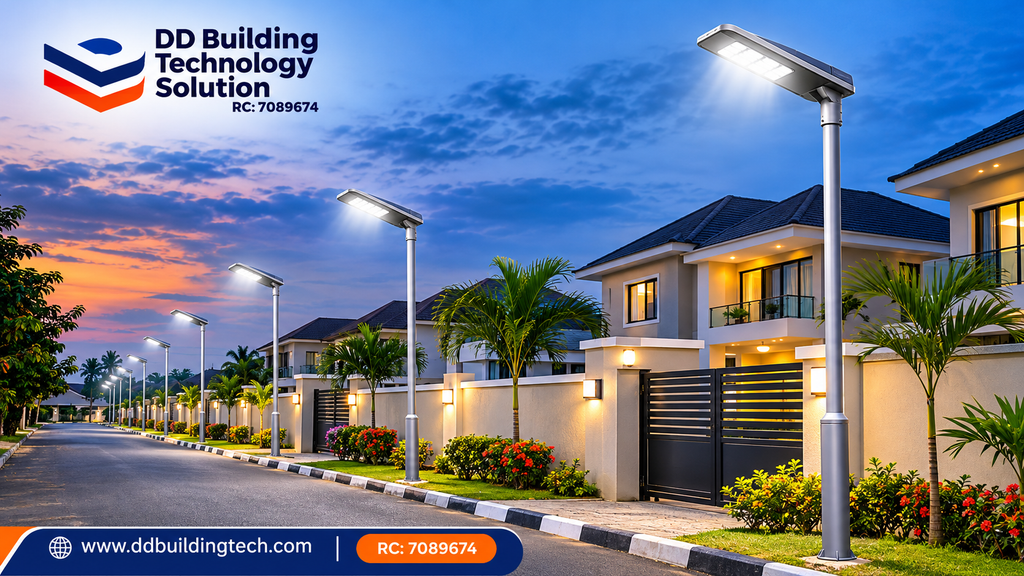
Walk through almost any estate in Nigeria after dark, and you can tell within a minute whether someone planned the lighting or just bought some. On one road, the lights are even, the junctions are bright, and residents walk their dogs at night. On the next, three poles are dark, one light flickers, and a stretch near the gate is so dim that people stop using it. The difference is rarely the budget. It’s whether the buyer knew what to ask before paying.
This guide is for estate developers, facility managers, residents’ associations, and compound owners who are comparing the solar street light price in Nigeria against what they actually get for the money. We’ll explain how all-in-one lights work, give you a checklist you can use with any supplier, list our current models and prices, and work through a real 400-meter estate road so you can see how a project budget comes together.
Why Solar Street Lights Suit Nigerian Estates
A conventional street light needs a grid connection, cable run along the whole road, switchgear, a meter, and a monthly bill that someone has to collect from residents. When the grid is down, the road is dark. When the bill goes unpaid, the road is dark. Many estates end up running a generator for the lighting circuit as well, which brings fuel costs, noise, and a person who has to remember to switch it on.
Solar removes most of that. There’s no trenching, no cable between poles, no meter, and no electricity bill. The light turns itself on at dusk and off at dawn. For an estate that’s being built or retrofitted in phases, you can light one road this month and the next road later, without redesigning anything.
It isn’t free of drawbacks, and we’d rather you hear them from us. The upfront cost per pole is higher than a grid-connected light, even if the lifetime cost isn’t. Panels and batteries are targets for theft in some areas. A light placed under a tree or beside a tall building won’t charge properly. And a poor-quality unit will fail in the second rainy season, which is when the real cost shows up. The rest of this guide is about avoiding those traps.
What “All-In-One” Actually Means
Most estate lights sold in Nigeria today are all-in-one units. The solar panel, battery, charge controller, and LED lamp are built into a single fixture that bolts onto the top of a pole. There’s no separate panel on the roof and no cable running down the pole to a battery box.
That design has real advantages. Installation is fast because there’s one unit to lift and fix. There’s very little wiring to go wrong. Replacing a failed unit is a matter of swapping one fixture.
The trade-off is that the panel’s size and angle are fixed by the design. A larger lamp usually means a larger panel, which means a bigger fixture on the pole. The panel also faces whichever way the fixture is pointed, so aiming it properly at installation matters. For fixed panels in Enugu, one location-based solar analysis suggests a slight southward tilt of around 7 degrees, which is close to flat, so the main job is making sure nothing shades the panel for most of the day.
Split systems, with a separate panel and battery on or at the base of the pole, give you more flexibility for large lights, but they cost more to install and have more parts to protect from tampering. For most residential estates and compounds, all-in-one is the sensible default.
The Buyer’s Checklist: Ten Things to Ask Any Supplier
Whoever you buy from, ask these before you pay. Most of them take one phone call to answer, and a supplier who can’t answer them is telling you something.
1. What is the lumen output, not just the wattage? Watts describe how much power a lamp draws. Lumens describe how much light it produces. Two lights with the same advertised wattage can differ enormously in brightness, and some marketing wattages are inflated. One manufacturer’s buying guide recommends asking for the light you need at ground level, as an average and a minimum, and not only the peak under the lamp.
2. What is battery chemistry and capacity? Look for lithium iron phosphate, usually written as LiFePO4. It handles daily charging better than older chemistries and is more stable in heat, and the same guide expects a quality LiFePO4 battery to deliver several years of daily service.
3. How many nights will it run with no sun? This is called autonomy, and it matters most during the rainy season. The guide suggests looking for at least two to three days of autonomy. Ask for the figure for the specific model, not the product range.
4. What type of panel is it? Monocrystalline panels are generally more efficient for their size, which matters on an all-in-one head where there’s little room for a bigger panel. We cover the difference in our guide to monocrystalline vs polycrystalline panels.
5. What controller does it use? An MPPT controller wrings more charge out of the panel than a basic one. Our MPPT vs PWM guide explains why that matters.
6. What is the ingress protection rating? The IP rating tells you how well the fixture resists dust and water. For outdoor lighting in Nigeria’s rain, the guide we’ve been quoting says to look for IP65 or IP66.
7. What does the beam pattern look like? A light that throws a narrow beam onto the road is good for a straight street. One that spreads light wider suits a car park or a junction. Ask what the fixture is designed for.
8. What lighting modes does it offer? Some lights run at full brightness all night. Others run bright for the first part of the night and then dim, or brighten when a sensor detects movement. Dimming stretches the battery and is useful on quiet internal roads.
9. What is the warranty, and what does it cover? Ask whether the battery is covered, for how long, and whether a replacement battery is available locally in two or three years. A warranty that only covers the LED isn’t much comfort.
10. What does the pole need to be? Pole height, wall thickness, foundation depth, and wind loading all matter. A good light on a weak pole is still a failed installation.
Several of these come from manufacturer guides, so treat them as a sensible starting checklist and not as an independent standard. They’re also the questions we’d want answered if we were the ones buying.
Our Current Range and Prices
To put real figures on the solar street light price in Nigeria, here is what we currently stock, listed as it appears in our price list. Model names such as the Eye series and the Y series are the manufacturer’s own.
| Model | Type | Price (₦) |
|---|---|---|
| 2 Eye KJT All-In-One | Street light | 26,000 |
| 3 Eye KJT All-In-One | Street light | 27,200 |
| Y8 KTJ All-In-One | Street light | 28,500 |
| Y10 KTJ All-In-One | Street light | 31,100 |
| 4 Eye KTJ All-In-One | Street light | 32,400 |
| 5 Eye KTJ All-In-One | Street light | 42,800 |
| Y24 KTJ All-In-One | Street light | 55,800 |
| 24 Eye Solar Street Light | Street light | 55,800 |
| 50W KTJ SFL | Solar flood light | 28,500 |
| 100W KTJ SFL | Solar flood light | 28,500 |
| 200W KTJ SFL | Solar flood light | 35,000 |
| SUKHIG 200W Solar Flood Light | Solar flood light | 38,000 |
| 300W KTJ SFL | Solar flood light | 53,200 |
| J3 Industrial Light | Industrial | 65,000 |
| SMS 300W Double Panel | Street light | 95,000 |
Prices come from our current price list, are per fixture, and exclude the pole, foundation, and installation. They move with the exchange rate, so message us on WhatsApp to confirm today’s price and stock. For each model, ask us for the datasheet showing rated output, battery capacity,y and autonomy before you decide.
The pattern is worth noticing. The step from the entry models at around ₦26,000 to ₦32,000 up to the top-end street lights at ₦55,800 is roughly double the price per pole. Whether that’s money well spent depends entirely on where the light is going, which is the next question.
Matching the Light to the Space
Not every part of an estate needs the same light. Putting your best fixtures everywhere wastes money, and putting entry-level units on a main road leaves it patchy. Here is how we usually think about it. These are starting points, and we confirm the output of the actual model against your site before recommending anything.
| Space | What it needs | Where to start in our range |
|---|---|---|
| Main estate road | Even light over a long stretch, bright enough for vehicles | Higher-output all-in-one street lights, such as the Y24 or 5 Eye |
| Internal streets and cul-de-sacs | Enough light to see and walk safely | Mid-range all-in-one lights, such as the Y10 or 4 Eye |
| Gate, gatehouse and entrance | Bright, wide light for identification and security | Higher-output street lights, plus a flood light on the gatehouse |
| Car parks and open areas | Widespread over a large area | Solar flood lights, from 100 W up to 300 W |
| Perimeter and fence line | Consistent coverage, resistant to tampering | Flood lights or street lights mounted high |
| Small compounds and school grounds | Modest coverage at a modest cost | Entry-level all-in-one lights, such as the 2 Eye or 3 Eye |
If your estate has a gatehouse, it’s worth thinking about security as a package. Lighting makes cameras more useful at night, which is why many estates combine lights with CCTV installation and access control at the gate. Our guide to CCTV installation cost in Nigeria shows what the camera side costs.
Pole Height and Spacing: How Many Lights Do You Need?
This is the part buyers most often get wrong, because the answer depends on the road, not the light.
As a general guide, many paths and streets are planned with poles spaced at around three to four times the mounting height, according to the same buyer’s guide, with a proper lighting plan needed for large projects. Here is what that looks like for common pole heights:
| Pole height | Typical spacing (3 to 4 times height) |
|---|---|
| 5 metres | 15 to 20 metres |
| 6 metres | 18 to 24 metres |
| 8 metres | 24 to 32 metres |
Taller poles spread light further but reduce the brightness at ground level. Shorter poles give brighter, more concentrated light but need to be closer together. For most residential estate roads, five to six metres is a practical middle ground: tall enough to light the road evenly, and short enough to install and maintain without special equipment.
Use this table to get to a rough number, then adjust. Junctions, bends, speed bumps, gates and pedestrian crossings all need extra attention, and dark patches between poles are common when spacing is stretched to save money.
A Worked Example: Lighting a 400-Metre Estate Road
Let’s put real numbers on the solar street light price in Nigeria for a typical estate road. Suppose you have a 400-metre road and plan to light one side with six-metre poles spaced 20 metres apart, which sits comfortably inside the 18 to 24 metre guide.
That’s 400 ÷ 20 = 20 intervals, so 21 poles, because you need one at each end.
Here’s what the fixtures alone would cost for 21 units, using our current prices:
| Fixture | Price each (₦) | 21 fixtures (₦) |
|---|---|---|
| 2 Eye KJT All-In-One | 26,000 | 546,000 |
| Y8 KTJ All-In-One | 28,500 | 598,500 |
| Y10 KTJ All-In-One | 31,100 | 653,100 |
| 4 Eye KTJ All-In-One | 32,400 | 680,400 |
| 5 Eye KTJ All-In-One | 42,800 | 898,800 |
| Y24 KTJ All-In-One | 55,800 | 1,171,800 |
The choice of fixture moves the fixture cost by more than ₦600,000 on a single road. That’s why it’s worth getting the output right for the space rather than defaulting to the cheapest or the most expensive.
Remember what’s not in the table: the poles, the concrete foundations, the labour and the transport. These depend on pole height, soil conditions and access, so we price them against your site. If you light both sides of the road, or stagger the poles, the count changes. Lighting both sides of the same road with opposite poles at 24-meter spacing, for instance, works out at 34 poles.
For a larger estate with several roads, bulk pricing is available. Tell us the total number of fixtures when you ask for a quote, because pricing 100 units is a different conversation from pricing five.
How Installation Works
A well-run installation follows the same sequence every time.
Site survey. We walk the road or compound, note where shade falls, check existing poles, and agree on pole positions. This is also when we confirm whether you need new poles or can use existing ones.
Foundations and poles. If new poles are needed, foundations are cast and poles erected and left to set. Rushing this stage causes leaning poles later.
Mounting and aiming. Each fixture is bolted to its pole and aimed so the panel faces open sky and the beam falls where you want it. A few degrees of error at the top of a six-metre pole becomes a visible dark patch on the road.
Commissioning at dusk. We check that every light comes on by itself and that the dimming mode is set as agreed. Doing this at dusk, and not at midday, is the only way to know it works.
Handover. You get a list of what was installed, where, and which model, along with the warranty terms. That list becomes the maintenance record.
Our solar street light installation service covers all of this, and you can browse current stock on our Solar Street Lights.
Keeping the Lights Working
Solar street lights are low-maintenance, not no-maintenance. A few habits keep a road lit for years.
Clean the panels a couple of times a year, and after the dry-season dust, because a dusty panel charges less. Trim any tree growth that starts to shade a fixture. Walk the road once a month at night and note any dim light, flickering, or off, so a small fault gets fixed before it becomes five. Check that bolts are tight, particularly after storms. And keep a record of install dates, so you can plan for battery replacement before the lights start to fail. Lithium batteries last for years, but they don’t last forever.
For estates, we recommend agreeing a maintenance arrangement at the time of purchase, so that responsibility is clear when something goes wrong.
What About Theft?
It’s a fair concern. All-in-one lights put a panel and battery on top of a pole, and in some areas that makes them a target. There’s no way to remove the risk entirely, but you can reduce it a lot.
Mount lights at a sensible height, so they can’t be reached from the ground or a wall. Use anti-theft fasteners rather than standard bolts. Put the most exposed positions, such as roadside plots and unmanned boundaries, in view of a camera or the gatehouse. And involve residents, because lights that people feel responsible for are lights that people notice when someone interferes with them.
Good lighting also reduces the opportunity for theft in the first place, which is part of why estates invest in it.
Six Mistakes We See Repeatedly
Buying by watts. Compare lumens, battery capacity, and autonomy instead.
Ignoring shade. A premium light under a mango tree performs worse than a basic light in open sun.
Stretching the spacing. Fewer poles save money on the quote and cost you in dark patches and complaints.
Choosing the cheapest unbranded unit. The price difference per pole is small compared with the cost of replacing a road’s worth of failed batteries.
Skipping the warranty details. Ask what’s covered, for how long, and whether replacement parts are available locally.
Not testing a sample. For a large project, install two or three poles first, watch them through a few nights of weather, and then commit to the rest.
Planning an estate or compound project? Chat with DD Building Tech on WhatsApp with the road length, the number of poles you’re considering, and your location. We’ll recommend the right fixtures, give you a bulk price, and arrange a site visit.
Frequently Asked Questions
What is the solar street light price in Nigeria?
It depends on the model and output. Our current all-in-one street lights range from ₦26,000 for entry-level units to ₦55,800 for the higher-output models, per fixture. Poles, foundations, and installation are priced separately, and bulk orders qualify for better rates.
How many solar street lights do I need for an estate road?
As a guide, plan poles at three to four times the mounting height. For six-metre poles, that’s 18 to 24 metres apart, so a 400-metre road lit on one side needs about 21 poles at 20-metre spacing. A site survey adjusts this for junctions, bends, and shade.
Do solar street lights work in the rainy season?
Yes, if the battery has enough autonomy. Look for at least two to three days of reserve, and make sure nothing shades the panel. Output drops on cloudy days, but a correctly specified light keeps running.
How long do solar street lights last?
A quality LiFePO4 battery is expected to give several years of daily service, and the buying guide we’ve cited suggests looking for at least three to five years of warranty on components. Ask for the battery warranty in writing.
What’s the difference between a solar street light and a solar flood light?
A street light is designed to light a road or path from a pole. A flood light spreads light over a wide area, which suits car parks, building fronts, and perimeters.
Can you install solar street lights on existing poles?
Often, yes, if the poles are structurally suitable and the right height. We check this at the site survey.
Do you offer bulk pricing for estates?
Yes. Tell us the total number of fixtures, and we’ll quote accordingly.
Light Your Estate Without Depending on the Grid
Whatever the solar street light price in Nigeria works out to for your project, tell us about your road or compound, and we’ll recommend the right fixtures, show you the full cost, and install them properly.
Browse our Solar Street Lights →
Get a solar street light installation quote →
We supply and install in Enugu and Anambra, with nationwide delivery everywhere else in Nigeria. If you’re also looking at the power side of your project, our guide to solar panel pricing in Nigeria shows what each wattage costs.