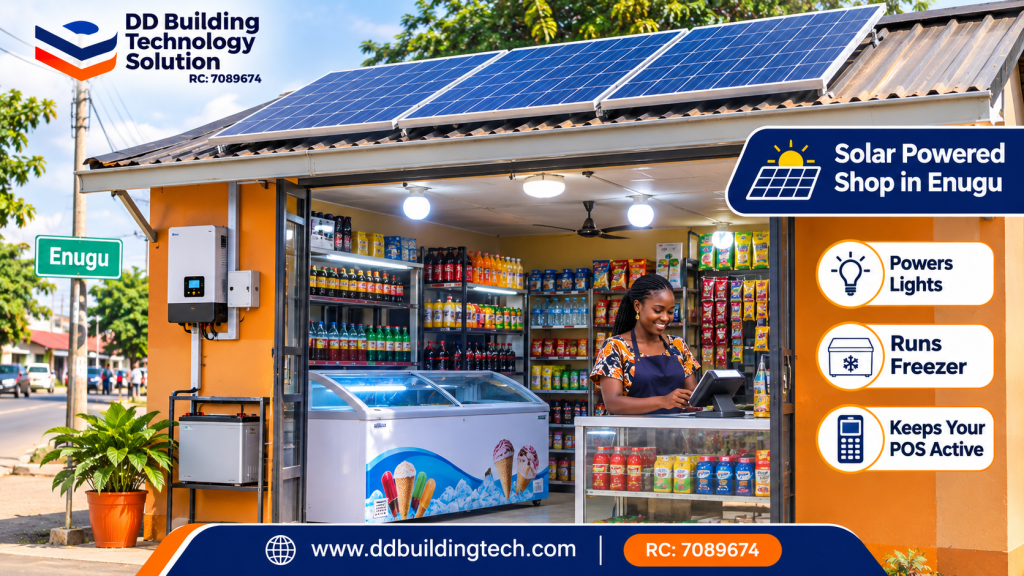
How to size a solar system for your shop or small business in Nigeria is a question every Nigerian citizen has because of the high increase in electricity tariffs and the current state of the country. Because of that, every citizen has focused on getting a solar system that will be suitable for their business, houses, and industries,s as the case may be.
Most shop owners who go solar for the first time do it in the wrong order. They hear a number from a neighbour, “I put 5KVA in my shop,” and they ask for 5 KVA. The neighbour’s shop has two freezers and an air conditioner. Yours sells phone accessories and runs a laptop. One of you has paid for far more than you needed, and the other might be about to.
Sizing is the whole job. Get it right, and the system runs your shop through the day, the generator stays in the corner, and the payback comes quickly. Get it wrong and you either spend money on capacity you never use or find the inverter tripping every afternoon. This guide shows how to size a solar system for shop owners in Nigeria, step by step, then works through two real examples using prices from our current price list, so you can see what a properly sized system costs and how fast it earns its money back.
Why Shops Are Good Candidates for Solar
A home uses most of its power in the evening and at night, when the sun is down. A shop is different. Most of your electricity use happens between about eight in the morning and six or seven in the evening, which is exactly when the panels are producing. That power goes straight from the panels to your loads, with no trip through the battery, so you lose less of it along the way.
That’s why a solar system for shop Nigeria trading hours can carry a smaller battery than a home system of the same size. It only has to cover the hours after the sun sets, the fridges and freezers overnight, and a short buffer for cloudy days. A well-designed shop system leans on panels and keeps the battery as lean as it safely can.
The sun is also reliable enough to plan around. A location-based analysis for Enugu using NASA data puts the average output at roughly 4.8 kWh per day for every kilowatt of panels in its lowest-output season, rising to about 5.7 in its best one. For sizing, we use a lower figure than either of those, which we’ll explain in a moment. If you want to check the solar resource at your own location, the Global Solar Atlas is a free map tool.
The Six Steps to Size a Solar System for Your Shop
Every solar system for shop use in Nigeria can be sized with the same six steps. You don’t need software. You need a pen, your appliance labels, and fifteen minutes.
Step 1: List every load. Write down each appliance, its power in watts, and how many hours a day it runs. The watts are printed on the label, usually on the back or base. For fridges and freezers, the compressor doesn’t run all day, so we use the rated watts multiplied by about 40 percent for the share of time it’s actually running. That’s a typical figure, and your own unit may differ.
Step 2: Work out daily energy. Multiply watts by hours for each item to get watt-hours, then add them up. Divide by 1,000 for kilowatt-hours. This number sets the size of your panel array and, indirectly, your battery.
Step 3: Find your peak load. Add up the watts of everything that could be running at the same moment. Then think about start-up surges. Motors, including fridge and freezer compressors, pull several times their running power for a split second when they start. This number sets the inverter size. As we explain in our hybrid vs pure sine wave inverter guide, a 3KVA inverter delivers roughly 2,400 watts of real power, and the surge rating matters as much as the continuous one.
Step 4: Size the battery for the hours without sun. Work out how much energy you use after dark and in the early morning, add a buffer for cloudy days, then divide by the usable depth of discharge of the battery type. Lithium can be used to roughly 80 percent of its rated capacity. Tubular and gel batteries are best kept to around 50 percent, as we explain in our lithium vs tubular battery comparison.
Step 5: Size the panels. Divide your daily kilowatt-hours by the energy each kilowatt of panels produces per day. We use 3.8, which is about 80 percent of Enugu’s lowest seasonal figure of 4.79, to leave room for dust, heat, cable losses, battery losses, and the odd run of grey days. Round up to a whole number of panels.
Step 6: Add protection and installation. Breakers, surge protection, cable, earthing, mounting and labour. These are easy to forget and expensive to skip. In our current list, protection devices run from ₦4,000 for a basic surge guard to ₦14,000 for surge protectors and larger DC breakers, and a well-built installation typically needs several.
Let’s put this into practice.
Worked Example 1: A Phone Accessories and POS Kiosk
A small kiosk that sells phone accessories, offers POS and printing services, and trades from about 8 am to 8 pm. It has no fridge or freezer.
Steps 1 and 2: Loads and daily energy.
| Appliance | Watts | Hours | Energy (Wh/day) |
|---|---|---|---|
| 6 LED bulbs (10W each) | 60 | 12 | 720 |
| Standing fan | 75 | 10 | 750 |
| POS terminal and printer | 20 | 12 | 240 |
| Laptop | 60 | 8 | 480 |
| Router | 15 | 12 | 180 |
| Phone charging station | 50 | 6 | 300 |
| Total | 2,670 |
That’s about 2.7 kWh a day.
Step 3: Peak load. Everything running together adds up to 280 watts. There’s no motor with a heavy start-up surge, so even a small inverter could cope. We’d still recommend a 2KVA unit for headroom, because kiosk owners nearly always add something later, whether a fridge, a second laptop,p or a TV.
Step 4: Battery. Most of the load happens in daylight, so the battery only has to cover a couple of hours after dark and give a buffer for a dull day. A battery bank of about 2.5 kWh usable is plenty. At 50 percent depth of discharge, two 220Ah 12V tubular batteries wired for a 24V system give about 5.3 kWh of nominal capacity and 2.6 kWh usable, which matches. For a load this small, tubular is a sensible choice.
Step 5: Panels. 2.67 kWh ÷ 3.8 = 0.70 kW. Two 450-watt panels give 900 watts, with a comfortable margin.
Parts list and cost:
| Component | Specification | Price (₦) |
|---|---|---|
| Inverter | 2KVA SMS Hybrid Inverter | 350,000 |
| Solar panels | 2 × 450 Watt Panels | 250,000 |
| Batteries | 2 × 220Ah 12V Tubular Battery | 520,000 |
| Equipment subtotal | 1,120,000 | |
| Installation, cabling and protection (estimate) | 100,000 – 200,000 | |
| Estimated total | ₦1,220,000 – ₦1,320,000 |
This assumes the 2KVA inverter runs on a 24V battery bank, which we confirm against the model’s specification sheet at quote stage. Hybrid inverters typically include a built-in solar charge controller, so there’s usually no separate controller to buy; we confirm that for the exact model. Our MPPT vs PWM guide explains what that built-in controller does.
Payback. A kiosk that currently runs a generator for four hours a day spends about ₦131,520 a month on fuel, using the figures from our solar vs generator comparison (₦1,370 per litre at 0.8 litres an hour, or about ₦1,100 for each hour the generator runs). If solar replaces all of that, the system pays for itself in roughly nine to ten months. If the generator runs longer, the payback is faster.
Worked Example 2: A Provision Store with a Freezer and Fridge
A mini-mart that trades from about 8 am to 9 pm and keeps a chest freezer and a display fridge running around the clock.
Steps 1 and 2: Loads and daily energy.
| Appliance | Watts | Hours | Energy (Wh/day) |
|---|---|---|---|
| 10 LED bulbs (10W each) | 100 | 12 | 1,200 |
| 2 ceiling fans (75W each) | 150 | 10 | 1,500 |
| Chest freezer (about 40% duty, 24 hours) | 200 | 24 | 1,920 |
| Display fridge (about 40% duty, 24 hours) | 150 | 24 | 1,440 |
| POS terminal and printer | 20 | 12 | 240 |
| Router | 15 | 12 | 180 |
| Laptop | 60 | 6 | 360 |
| Phone chargers | 30 | 4 | 120 |
| Total | 6,960 |
That’s about 7 kWh a day, almost three times the kiosk.
Step 3: Peak load. The running loads add up to about 725 watts. The freezer and fridge compressors can each pull several times that when they start, so the realistic peak, with both starting while the lights and fans are on, is around 1.7 kW. That sits inside a 3KVA-class inverter, and we’d choose the 3.6KVA SMS hybrid for headroom, because shops rarely stay the same size.
Step 4: Battery. The energy used when the sun is down is the part that matters. Overnight, the freezer and fridge use about 1,680 Wh. The shop usually trades for a couple of hours after dark, adding roughly 675 Wh for lights, fans, and POS. That’s about 2.4 kWh, and we add a buffer of around 50 percent for dull days, so the target is about 3.5 kWh usable.
- Lithium: 3.5 kWh ÷ 0.8 = 4.4 kWh nominal. One 5kWh lithium battery covers it.
- Tubular: 3.5 kWh ÷ 0.5 = 7 kWh nominal. In practice, that means four 220 Ah 12 V batteries, because the bank has to be built in even numbers to match the inverter’s voltage.
Step 5: Panels. 6.96 kWh ÷ 3.8 = 1.83 kW. Four 550-watt panels give 2,200 watts, which clears it with a margin.
Parts list and cost, both versions:
| Component | Lithium build (₦) | Tubular build (₦) |
|---|---|---|
| 3.6KVA SMS Hybrid Inverter | 480,000 | 480,000 |
| 4 × 550 Watt Panels | 500,000 | 500,000 |
| Battery | 5kWh Taico Lithium: 1,050,000 | 4 × 220Ah Tubular: 1,040,000 |
| Equipment subtotal | 2,030,000 | 2,020,000 |
| Installation, cabling and protection (estimate) | 150,000 – 300,000 | 150,000 – 300,000 |
| Estimated total | ₦2,180,000 – ₦2,330,000 | ₦2,170,000 – ₦2,320,000 |
Look at the bottom line. When the tubular bank is sized to give the same usable energy as the lithium battery, the two builds cost almost exactly the same upfront. That surprises people, because tubular looks so much cheaper per battery. The gap closes because lead-acid can only be used to half its capacity, so you need roughly twice as much of it. The difference then shows up over time: lithium is expected to last far longer, as we cover in the battery comparison. For a shop with a freezer, that’s a strong argument for lithium.
Payback. Using the same generator cost of about ₦1,100 an hour:
| Generator use before solar | Fuel spend per month | Payback, either build |
|---|---|---|
| 4 hours a day | ₦131,520 | about 17 months |
| 6 hours a day | ₦197,280 | about 11 to 12 months |
| 8 hours a day | ₦263,040 | about 8 to 9 months |
These assume solar replaces all of your generator hours. If it covers about 80 percent, with a backup for long cloudy spells, add roughly a quarter to each figure. Fuel prices have moved by hundreds of naira within a few months, so check the current pump price and adjust.
What If You Have an Air Conditioner?
An air conditioner changes everything, so it deserves its own section. A typical 1HP unit draws around 900 watts. Run for eight hours, it uses about 7.2 kWh a day, which is as much as the entire mini-mart above. One air conditioner roughly doubles a shop’s energy use.
The most economical way to add one is to run it in the daytime only, so it runs straight off the panels and needs no extra battery. That means roughly 1.9 kW of extra panels (7.2 ÷ 3.8), which is another four 550-watt panels at about ₦500,000. You’d also step up the inverter, because an AC compressor has a hefty start-up surge. The 6.2KVA Sako hybrid at ₦550,000 is ₦70,000 more than the 3.6KVA SMS hybrid in the example above.
Running the air conditioner at night needs a much bigger battery, which is where the cost climbs fast. Be aware, too, that a larger array has to fit within the inverter’s solar input rating, so a big addition sometimes means a larger inverter or a second one. We check that at the design stage. If your load is heading into that range, our 5KVA solar system cost guide shows what a bigger build looks like.
Where Shop Owners Go Wrong
Most problems with a solar system for shop owners in Nigeria come down to one of the mistakes below.
Sizing from the generator. A 3KVA generator doesn’t mean you need a 3KVA solar system. Size from your actual loads.
Forgetting the surge. The freezer and fridge are small loads that start with a big kick. An inverter that’s fine on paper can still trip when both compressors start at once.
Leaving out the next appliance. If you plan to add a second freezer or an AC in a year, say so now. It’s much cheaper to design in headroom than to rebuild later.
An undersized battery. A shop that loses its freezer contents overnight loses more than the cost of a bigger battery. Size for the night, with a buffer.
Shading the panels. A water tank, a neighbour’s wall, or a signboard that shades part of an array cuts output more than the shaded area suggests. For fixed panels in Enugu, the best tilt is only about 7 degrees south, which is nearly flat, so mounting is simple, but shade is the enemy.
Skipping protection. Lightning and power surges are a real risk in the rainy season. Surge protectors, correctly rated breakers,s and proper earthing are cheap next to the equipment they protect.
Never cleaning the panels. Dust, especially after the dry season, lowers output. A rinse a couple of times a year is cheap insurance.
Choosing the Equipment: A Quick Guide
Inverter. For most shops, a hybrid inverter in the 2KVA to 6.2KVA range, with a pure sine wave output and a built-in solar charge controller. Confirm the waveform and the solar input rating in writing. Browse our Solar Inverters.
Panels. Choose panels by price per watt and make sure the array fits the inverter’s solar input. Our guide to solar panel pricing in Nigeria shows what each wattage costs, and you can see current stock on our Solar Panels.
Battery. Tubular for small, light loads and tight budgets. Lithium when you have refrigeration, a long trading day, and plans to keep the system for years. See our Solar Batteries.
Cameras. If your shop also has CCTV, remember that a DVR and four cameras draw around 60 watts all day, which adds about 1.4 kWh to your daily load. Our CCTV installation service designs the two together.
If a full system isn’t affordable yet, a smaller step helps. Our Solar Generators can cover a POS terminal, laptop, and lights during the day, and you can build toward a full installation.
Get a Done-for-You Quote for Your Shop
You don’t have to work out any of this on your own. Send us the details below,w and we’ll do the sizing, specify the equipment, and send you a full quote, including installation, with a payback figure based on your own generator spend.
- Shop type and location (for example, provision store in Awka)
- Trading hours and days
- Appliances: each one with its watts from the label, or a photo of the label, and the hours it runs
- Generator use: hours a day and how much you spend on fuel in a month
- Photos of your roof or the space for panels, and of your distribution board
- Plans: anything you expect to add in the next year or two
- Budget range, if you have one
Ready to price a solar system for your shop? Copy the list above into WhatsApp, fill it in, and send it to us. We’ll reply with a recommended system, a full price, and a payback estimate.
Frequently Asked Questions
What size solar system do I need for my shop?
It depends on what you run and for how long. A small kiosk with lights, a fan, a laptop, and a POS terminal uses about 2.7 kWh a day and needs a 2KVA inverter with around 900 watts of panels. A provision store with a freezer and fridge uses about 7 kWh a day and needs a 3.6KVA inverter, around 2,200 watts of panels, and a 5kWh lithium battery.
How much does a solar system for a shop cost in Nigeria?
Using our current prices, a kiosk system comes to roughly ₦1.2 million to ₦1.3 million installed, and a provision store with a freezer and fridge comes to roughly ₦2.2 million to ₦2.3 million. Add an air conditioner and the cost rises by about ₦500,000 for extra panels plus a larger inverter, if it runs only in the daytime.
Can solar run a deep freezer in a shop?
Yes. A chest freezer uses roughly 1.9 kWh a day, and the panels cover it in daylight while the battery covers it overnight. It’s one of the main reasons shop systems need a decent battery, and it’s worth sizing for.
Should I choose lithium or tubular batteries for my shop?
For a small, light-load kiosk, tubular is sensible. For a shop with refrigeration that runs day and night, lithium usually makes more sense, because once the two are sized for the same usable energy, the upfront costs are close and lithium lasts much longer.
How long does it take to pay back a solar system for a shop?
If solar replaces generator fuel, the examples above pay back in roughly 8 to 17 months depending on how many hours a day the generator used to run. If you’re comparing against grid power only, the payback is longer.
Will the system work on cloudy and rainy days?
Yes, but at lower output. That’s why we size the panels on a figure well below the sunniest days and include a battery buffer. In Enugu, even the lowest-output season averages around 4.8 kWh a day for every kilowatt of panels, according to that same analysis.
Can I add more panels or batteries later?
Usually yes, provided the inverter’s ratings allow it. That’s why we design headroom into the inverter at the start, and why it pays to tell us about plans.
Size It Right the First Time
A properly sized solar system for shop Nigeria trading hours is one of the quickest-paying investments a small business can make. Tell us about your shop, and we’ll do the sums, specify the equipment, and install it properly.
Get a free load assessment & quote →
We install in Enugu and Anambra, with nationwide delivery everywhere else in Nigeria. You can also read our guide on how to reduce your electricity bill after the Band A tariff hike.