Introduction
“How much does a 5KVA solar system actually cost?” is one of the most searched solar questions in Nigeria, and it’s also one of the most consistently badly answered. Most of what you’ll find online is either a single vague number with no breakdown, or a price that turns out to only cover the inverter and nothing else in the system. Neither is useful when you’re actually trying to budget for a real purchase.
This guide breaks down every component that goes into a working 5KVA solar system, using real current pricing from our stock at DD Building Tech, and builds two complete worked examples: one with lithium batteries, one with tubular, so you can see exactly where your money goes and what trade-offs are available at each price point.
What a 5KVA System Is Actually For
Before the pricing, it’s worth being clear about what a 5KVA system realistically supports, since “5KVA” describes the inverter’s capacity, not the whole system’s power output. A 5KVA inverter comfortably handles a mid-size Nigerian household running lighting throughout the home, a refrigerator, a TV or two, fans, phone and laptop charging, a pumping machine, and modest, intermittent use of a small air conditioning unit. It is not typically sized for running multiple ACs simultaneously or heavy commercial equipment; those loads generally call for a larger inverter, which is a different budget conversation entirely.
This makes 5KVA the sweet spot for most 3-bedroom homes in Enugu, Anambra, and similar markets substantial enough to cover real daily life, without paying for commercial-grade capacity a typical household doesn’t need.
The Four Components That Make Up a Complete System
A working solar system isn’t just “an inverter”; it’s four components that all need to be correctly sized together:
- Solar panels: generate power from sunlight during the day
- Inverter: converts stored DC power into usable AC electricity for your appliances
- Battery bank: stores power for use at night or during cloudy periods
- Charge controller: regulates power flowing from panels into the battery, protecting it from overcharging (this is sometimes built into a hybrid inverter, but many standard inverter setups need one as a separate component)
Pricing any one of these alone and calling it “the cost of a 5KVA system” is exactly how so many online price estimates end up misleading; the inverter is often the smallest line item, not the biggest.
Worked Example 1: 5KVA System With Lithium Battery Bank
Here’s a complete, real parts list using current DD Building Tech stock:
| Component | Specification | Price (₦) |
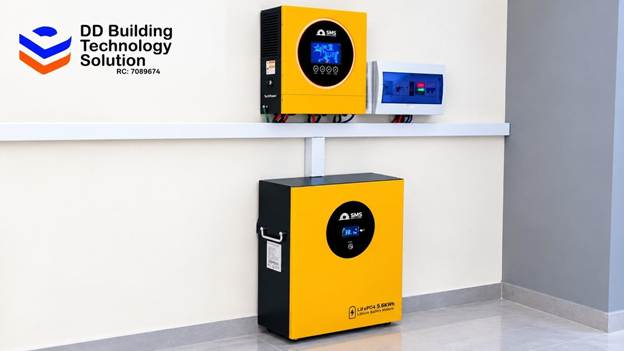
| Inverter | 5KVA 48V SMS Inverter | 500,000 |
| Solar Panels | 6 × 600 Watt Panels | 930,000 |
| Charge Controller | 120 Amps Felicity Charge Controller | 120,000 |
| Battery Bank | 2 × 5kWh SMS Lithium Battery (10kWh total) | 2,400,000 |
| Subtotal (equipment only) | 3,950,000 | |
| Installation, cabling & accessories (estimate) | Mounting hardware, cabling, breakers, labour | 200,000 – 400,000 |
| Estimated Total | ₦4,150,000 – ₦4,350,000 |
This configuration gives you a 10kWh usable-capacity lithium bank (since lithium can be safely discharged much deeper than lead-acid, as covered in our lithium vs tubular battery guide), a 3.6kW panel array that comfortably charges that bank across a full day of sun, and a charge controller sized with headroom above the array’s output.
Worked Example 2: 5KVA System With Tubular Battery Bank
For comparison, here’s the same system built with tubular batteries instead of lithium:
| Component | Specification | Price (₦) |
| Inverter | 5KVA 48V SMS Inverter | 500,000 |
| Solar Panels | 6 × 600 Watt Panels | 930,000 |
| Charge Controller | 120 Amps Felicity Charge Controller | 120,000 |
| Battery Bank | 4 × 220Ah 12V Tubular Battery (48V bank) | 1,040,000 |
| Subtotal (equipment only) | 2,590,000 | |
| Installation, cabling & accessories (estimate) | Mounting hardware, cabling, breakers, labour | 200,000 – 350,000 |
| Estimated Total | ₦2,790,000 – ₦2,940,000 |
This version costs roughly ₦1,300,000-₦1,400,000 less upfront than the lithium build — a real, significant difference. The trade-off, as covered in detail in our battery comparison guide, is that tubular batteries should generally only be discharged to around 50% of capacity to preserve their lifespan and typically need replacement every 2-3 years under daily cycling, versus a decade or more for the lithium option. Whether that upfront saving is the right choice depends on your budget constraints today versus your total cost over a 10-year ownership period.
Why These Numbers Might Look Different From Other Quotes You’ve Seen
If you’ve gotten a solar quote elsewhere that’s noticeably cheaper than these figures, a few things are usually behind the gap, and they’re worth checking before assuming you’ve found a better deal:
Undersized components. A “5KVA system” quoted well below these figures often means a genuinely smaller battery bank or fewer panels than what’s actually needed to run a 5KVA inverter properly; you end up with an inverter that trips constantly or a battery that dies by mid-evening, because the surrounding components were undersized to hit a lower headline price.
Substandard or mislabelled equipment. Panels rated at less than their advertised wattage, batteries with less real capacity than stated, or components without genuine brand documentation can all shave real cost off a quote while shaving real performance off the system too.
Installation excluded entirely. Some quotes cover equipment only, with cabling, mounting, and labour presented as a separate (often surprising) add-on cost once you’re already committed.
Exchange rate timing. Because the vast majority of solar equipment sold in Nigeria is imported and priced in dollars at the source, a quote from several weeks ago may simply reflect an exchange rate that’s since moved.
How to Reduce Cost Without Undersizing Your System
If the lithium build is outside your current budget but you don’t want to fully drop to tubular either, there are more reasonable ways to bring the number down than undersizing core components:
Start with a smaller battery bank and expand later. A single 5kWh lithium battery instead of two brings the lithium build’s subtotal down by roughly ₦2,400,000 to ₦1,200,000 more affordable, giving you a smaller but still genuinely lithium-based system you can expand with a second battery once budget allows.
Choose 480W panels instead of 600W. Slightly reducing panel wattage per unit (while potentially adding one more panel to compensate) can shift cost modestly without meaningfully undersizing your charging capacity, depending on your specific daily usage pattern.
Phase the purchase. Buy the inverter, charge controller, and panels first, and run on a smaller starter battery while saving toward the full lithium bank, a legitimate approach we support for customers building toward a complete system over a few months rather than all at once.
What we’d caution against is undersizing the inverter or panel array itself to hit a lower number; those are the components hardest and most expensive to upgrade later without significant rework, unlike a battery bank, which can genuinely be expanded incrementally.
What’s Not Included in These Figures
These worked examples cover a complete, functioning system, but a few things are worth flagging as potential additional costs depending on your specific property: structural mounting work if your roof needs reinforcement or a custom mounting frame, distance-related cabling costs if your inverter/battery room sits far from your panel mounting location, and electrical panel upgrades if your property’s existing wiring needs work to properly integrate with a new solar system. Our free site assessment identifies any of these before you commit to a final number, so there are no surprises mid-installation.
Get an Exact Quote for Your Property
These worked examples use real component pricing, but your actual system should be sized around your specific appliances and daily usage, not a generic “5KVA” template. Our Solar Installation service includes a free load assessment before we recommend anything, and you can browse current stock directly on our Solar Panels, Inverters, and Batteries pages.
Want this exact 5KVA system quoted for your property? Chat with DD Building Tech on WhatsApp, and we’ll confirm current pricing and availability, and adjust the parts list to fit your actual appliances.
Why 6 Panels at 600W, Specifically?
The panel count and wattage in these worked examples aren’t arbitrary; they’re sized to properly charge the battery bank within a reasonable daily sun window. Six 600W panels give a total array output of 3,600 watts. Under good Nigerian sun conditions (roughly 4-5 peak sun hours per day on average, accounting for cloud cover and seasonal variation), that array can generate somewhere in the range of 14-18kWh on a strong day, comfortably enough to fully recharge a 10kWh lithium bank or a 48V tubular bank with room to spare for same-day household consumption while the sun is up.
If you undersize the panel array relative to your battery bank, you end up with a battery that never fully charges, which defeats the purpose of having that storage capacity at all. If you oversize the array relative to a smaller battery, you’re generating power you have nowhere to store once the battery is full during the day- not dangerous, but not cost-efficient either. The 6-panel, 3,600W array in these examples is deliberately matched to the battery capacities shown, which is exactly the kind of calculation that goes wrong when a system is assembled piecemeal from whatever’s cheapest in each category rather than designed as a matched set.
Why the Charge Controller Matters More Than Its Price Tag Suggests
At ₦120,000, the charge controller is the smallest line item in both worked examples, but it’s doing a job that protects the far more expensive battery sitting next to it. The 120 Amp Felicity Charge Controller in these examples is sized with headroom above what a 3,600W array at 48V requires (roughly 75 amps under peak output), which matters because undersizing a charge controller relative to your panel array can mean it can’t handle peak output safely, while a controller with reasonable headroom continues operating well within its rated capacity even under the strongest sun conditions.
This is also where MPPT versus PWM controller technology matters, covered in more depth on our Charge Controllers page — an MPPT controller like the Felicity model in these examples typically extracts meaningfully more usable power from the same panel array than an equivalent PWM controller, which is part of why we default to MPPT in system designs at this scale.
What Happens After Year One: Realistic Maintenance Costs
A complete cost picture should also account for what happens after installation, not just the day-one purchase. For the lithium build, realistic ongoing costs are genuinely low for the first several years — periodic panel cleaning (which you can often do yourself, or have handled during a service visit) and occasional system checks are typically the only recurring costs, since the lithium battery bank isn’t expected to need replacement within the first decade under normal use.
For the tubular build, budgeting for a battery replacement within 2-3 years is the realistic expectation under daily cycling, as covered in detail in our lithium vs tubular comparison. At roughly ₦1,040,000 for the same 4-battery configuration at today’s pricing, that’s a cost worth planning for from the start rather than treating the tubular build’s lower upfront price as the complete financial picture.
How This Compares to Running a Generator Instead
It’s worth putting the ₦2,790,000-₦4,350,000 range into perspective against the alternative most Nigerian households and small businesses are actually weighing against: continuing to rely on a generator. A mid-size generator sufficient to cover similar household needs typically costs a fraction of a full solar system upfront, but fuel costs for daily or near-daily use commonly run into hundreds of thousands of naira annually, before accounting for generator maintenance, part replacement, and the eventual cost of replacing the generator itself every few years under heavy use.
Run that comparison forward five years, and the total cost of generator fuel and upkeep alone often approaches or exceeds what the solar system costs upfront, while the solar system continues producing power at effectively zero marginal cost per unit of electricity for the rest of its working life. This is genuinely the core financial argument for solar in the Nigerian context: a higher upfront cost that converts an ongoing, unpredictable monthly expense into a fixed one-time investment.
Financing the Purchase in Stages
For many households and small businesses, the full upfront cost of either build is the real barrier rather than a lack of interest in solar itself. Beyond the phased-purchase approach mentioned above, it’s worth asking directly whether instalment or staged-payment arrangements are available when requesting your quote; this varies by installer and by the size of the purchase, so it’s a genuine question worth raising rather than assuming either way. The key principle stays the same regardless of how payment is structured: size the core components (inverter, panel array) correctly from the start, and treat the battery bank as the part of the system most reasonable to scale up incrementally as budget allows.
Frequently Asked Questions
Is ₦4,000,000 enough for a complete 5KVA solar system? Yes, roughly our lithium-based worked example lands around ₦4,150,000-₦4,350,000 fully installed, while a tubular-based build comes in significantly lower at around ₦2,790,000-₦2,940,000, depending on current component pricing.
Why is the battery the most expensive part of my 5KVA system? Because it’s what determines how many hours of backup you actually get, a small, cheap battery bank paired with a 5KVA inverter will run out of stored power quickly regardless of how good the inverter is, which is why battery capacity typically represents the highest single cost in a properly sized system.
Can I reduce cost by buying a smaller inverter instead? Only if your actual appliance load genuinely fits a smaller inverter. Undersizing the inverter to save money while running a full home’s worth of appliances risks constant tripping and won’t actually save money once you factor in the frustration and potential need to upgrade later.
Do these prices include installation? The equipment subtotal doesn’t, but the estimated total range does include a reasonable installation, cabling, and accessories allowance; always confirm this is included when comparing quotes from any supplier, since some quotes cover equipment only.
How long does installing a 5KVA system take? Most standard residential 5KVA installations are completed within one to two days, depending on roof accessibility and any additional structural or electrical work needed.
Get Your 5KVA System Quoted Today.
Skip the guesswork on pricing. DD Building Tech will confirm exact current costs for the system that fits your home, using genuine, warrantied components from panels through to battery.
Get a free load assessment & quote. Chat with us on WhatsApp
Installed by a team based right here in Enugu and Anambra, with nationwide delivery and installation available everywhere else across Nigeria.