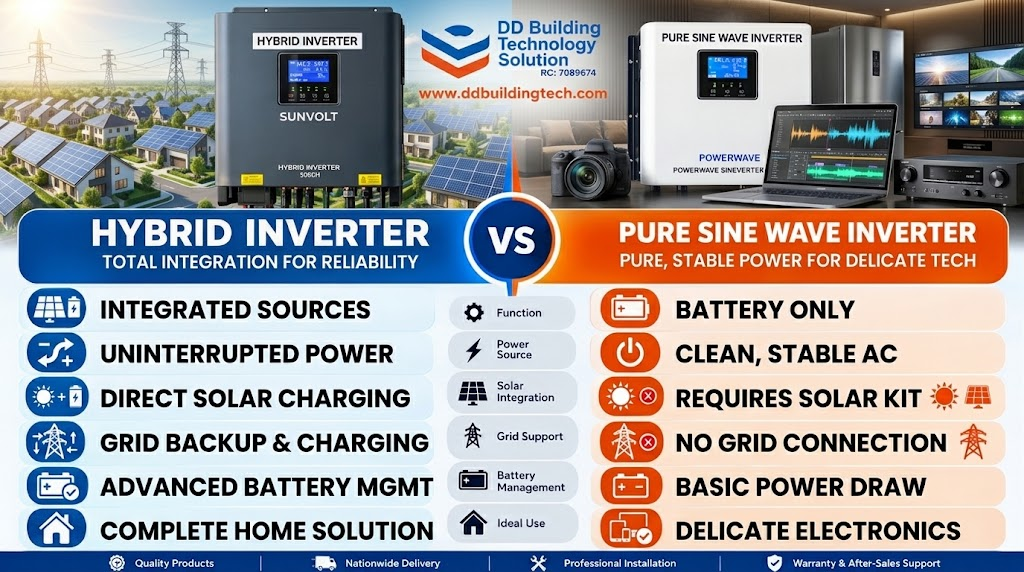
Ask three different vendors whether you should buy a hybrid inverter or a pure sine wave inverter, and you’ll get three confident answers that don’t agree with each other. That isn’t because two of them are lying. It’s because the question itself mixes up two different things, and most of the confusion people carry into a purchase starts right there.
Hybrid and pure sine waves are not rivals. One describes what an inverter does with different power sources. The other describes the quality of the electricity it produces. A single machine can be both, and plenty of the inverters sold in Nigeria today are. Once you see that, the “hybrid vs pure sine wave inverter Nigeria” question turns into two much simpler questions, and you can answer each one for your own home or shop.
At DD Building Tech, we size and install inverters for homes, shops, and small offices in Enugu, Anambra, and beyond, and this guide is the conversation we have at the start of almost every one of those jobs. It uses prices from our current price list so you can see real naira figures, not vague ranges.
First, Untangle the Two Terms
Pure sine wave is about the shape of the AC electricity coming out of the inverter. The grid delivers a smooth, wave-shaped current, and appliances are built to expect it. A pure sine wave inverter reproduces that smooth shape. A modified sine wave inverter produces a rougher, stepped approximation, which cheap inverters use because it costs less to build.
Hybrid is about how the inverter manages its energy sources. A hybrid inverter can take power from solar panels, from a battery bank, and from the grid (or a generator), and it decides automatically which one should be feeding your house at any moment. It can also charge the battery from solar or from the grid, depending on how you set it.
So the real choices are these. On the waveform side: pure sine wave or modified sine wave. On the architecture side: hybrid, or a standard inverter-charger that mainly converts battery power to AC and tops the battery up from the grid. If someone asks “hybrid or pure sine wave?”, the honest reply is “both, probably, and let’s check the spec sheet.”
Why the Waveform Matters More Than People Think
A modified sine wave inverter will light a bulb and spin a basic fan without complaint. The trouble starts with the appliances Nigerian homes rely on most. Refrigerators, freezers, air conditioners, pumping machines, and anything else with an AC motor run hotter and less efficiently on a stepped waveform, and some of them hum or wear out sooner. Sensitive electronics such as laptops, modern TVs, decoders, and medical equipment can behave badly or be damaged. Renogy’s buyer’s guide on modified versus pure sine wave inverters lists the same pattern: simple loads cope, while motor-driven and electronic loads want pure sine wave, and it estimates that most motors draw around 20 percent more power on a modified sine wave.
For a household that runs a fridge, a TV, and a pumping machine, that’s nearly everything you own. This is why we treat pure sine wave output as the baseline for any home or shop system, not an optional upgrade. Where the real decision sits is the second question: hybrid or standard.
One practical point on specs. Most modern hybrid inverters output pure sine wave, but we would rather you confirm the waveform for the exact model than take anyone’s word for a whole category. When you ask for a quote, ask for the waveform to be stated. A genuine pure sine wave unit will have no trouble saying so in writing.
What a Hybrid Inverter Actually Does
Picture the day in a house with a hybrid inverter and a battery bank. In the morning, the sun comes up, and the panels start feeding the house directly. Anything the house isn’t using goes into the battery. By midday, the battery is full, and the panels carry the loads on their own. In the evening, as the panels fade, the inverter switches to the battery. If the battery gets low during a long cloudy spell, it can switch to the grid, or to a generator, and even recharge the battery from it, all without you touching anything.
That switching logic is the whole point. Many hybrid inverters let you choose an output priority, commonly something like solar first, then battery, then grid, or solar first, then grid, then battery. If you are on a Band A feeder and paying a high tariff for each unit, you can tell the machine to lean on solar and battery as much as possible and use the grid as the last resort. If your grid supply is erratic, you can tell it to hold the battery in reserve and use the grid when it’s there. The same machine behaves differently depending on your situation.
Many hybrids also come with a built-in solar charge controller, usually MPPT, so you connect panels straight into the inverter and don’t buy a separate controller. That saves a component and some cabling. If you want to know why that matters, our guide to MPPT vs PWM charge controllers explains what that built-in controller is doing.
What a Standard Inverter Does (And Where It Still Makes Sense)
A standard inverter, sometimes called an off-grid or inverter-charger, does a simpler job. It takes DC power from a battery and turns it into AC for your appliances. When the grid is on, it passes grid power through to your loads and uses some of it to charge the battery. It doesn’t know about solar. If you add panels, you need a separate charge controller sitting between the panels and the battery.
That sounds like a downgrade, but it isn’t always. A standard inverter with a modest battery is the simplest, cheapest way to survive power cuts if you don’t plan to add solar. Plenty of homes and shops in Nigeria run exactly this setup, and it works. It also gives you flexibility: you can start with the inverter and battery today, and add a charge controller and panels later when the budget allows.
The trade-off shows up when you do add solar. You pay for a separate controller, there’s more wiring and more things to configure, and the system is a little less clever about switching between sources. For anyone who already knows they want solar, a hybrid usually works out neater and, over time, cheaper.
Real Prices: What Hybrid and Standard Inverters Cost Right Now
To put numbers on the hybrid vs. pure sine wave inverter choice in Nigeria, here is how our current stock lines up, listed by type as it appears in our price list:
| Inverter | Type | Price (₦) |
|---|---|---|
| 2.4KVA Eastman Inverter | Hybrid | 180,000 |
| 2KVA SMS Inverter | Hybrid | 350,000 |
| 3KVA Sako Inverter | Hybrid | 450,000 |
| 2KVA Wellion Inverter | Hybrid | 480,000 |
| 3.6KVA SMS Inverter | Hybrid | 480,000 |
| 4.2KVA 24V SMS Inverter | Hybrid | 480,000 |
| 6.2KVA Sako Inverter | Hybrid | 550,000 |
| 12KVA SMS Inverter | Hybrid | 900,000 |
| 1.5KVA Mopower Inverter | Transformer-based | 170,000 |
| 1.5KVA Smarten Inverter | Standard | 250,000 |
| 1.7KVA Smarten Inverter | Standard | 260,000 |
| 2.5KVA Glow Energy Inverter | Standard | 265,000 |
| 2.5KVA Smarten Inverter | Standard | 350,000 |
| 3.6KVA SKE Inverter | Standard | 375,000 |
| 3.5KVA Smarten Inverter | Standard | 450,000 |
| 5KVA 48V SMS Inverter | Standard | 500,000 |
| 6.5KVA 48V SMS Inverter | Standard | 600,000 |
Prices come from our current price list and move with the exchange rate. Message us on WhatsApp to confirm today’s price and what’s physically in stock before you budget.
Two things stand out. First, hybrid inverters are not automatically the expensive option. A 3.6KVA SMS hybrid at ₦480,000 sits only ₦30,000 above a 3.5KVA Smarten standard inverter at ₦450,000, and ₦105,000 above the 3.6KVA SKE at ₦375,000. The premium is real, but modest for the capability you get. Second, a lot of the price difference between two inverters of the same KVA rating comes down to brand, battery voltage, and build quality, not the hybrid label alone. That’s why comparing by KVA on its own can mislead you.
KVA Isn’t Watts (And Why That Trips People Up)
Every inverter is sold by a KVA rating, but your appliances are rated in watts. The two are linked by the power factor, and for most inverters a 3KVA rating translates to roughly 2,400 watts of real power, give or take, depending on the model. So a “3KVA inverter” does not run 3,000 watts of appliances. It runs about 2,400.
Then there’s surge. Motors draw far more current for a split second when they start than when they run. A fridge compressor might run at around 150 watts but pull several times that on start-up. A pumping machine is worse. Your inverter has to survive those spikes, and the rated surge capacity is just as important as the continuous rating.
Here’s a typical household load, using common nameplate figures. Check your own appliances, since real numbers vary:
| Appliance | Approx. running load |
|---|---|
| 10 LED bulbs | 100W |
| 3 ceiling fans | 225W |
| TV and decoder | 100W |
| Fridge | 150W (higher surge on start) |
| Freezer | 200W (higher surge on start) |
| Laptop and phone charging | 100W |
| Router | 15W |
| Pumping machine | 750W (surge several times higher) |
Add that up and the running load comes to about 1,640 watts, with everything on at once. That sits comfortably inside a 3KVA inverter’s real capacity, but only just if the pump kicks in while the fridge and freezer are also starting. Add a 1HP air conditioner at around 900 watts, and you’re pushing past what a 3KVA unit should be asked to carry for long. That’s the situation where we recommend stepping up to 3.6KVA, 4.2 kVA, or 5KVA, and where people who bought on price alone find their inverter tripping every afternoon. If you want to see what a full 5KVA system costs end to end, our complete 5KVA solar system cost guide walks through two worked builds.
Battery Voltage: The Detail Nobody Mentions Until It’s Too Late
Inverters are built around a battery voltage, usually 12V, 24V, or 48V. Smaller inverters up to about 2KVA tend to be 12V or 24V. Larger ones, from around 3KVA and up, are usually 24V or 48V. This matters for three reasons.
First, it decides what batteries you buy and how you wire them. A 48V system is built from batteries in series, or from a 48V lithium battery. Second, higher voltage means lower current for the same power, which means thinner cables and less heat. That’s why bigger systems use 48V. Third, if you plan to upgrade later, starting on a 12V inverter can box you in. You’d have to replace the inverter and rewire the batteries to grow.
If you’re sizing a system that you expect to expand, this is worth thinking about on day one. Our lithium vs tubular battery guide covers how battery type and voltage fit together, including the lithium BMS compatibility check we run before any installation.
Which One Should You Actually Buy?
Here’s the hybrid vs pure sine wave inverter Nigeria decision, stripped down by situation.
A 2- to 3-bedroom home with no plan for solar yet, just survival through power cuts. A standard pure sine wave inverter with a sensibly sized battery is a sound choice. You can add panels and a controller later. If you’re even half-sure solar is coming within a couple of years, a hybrid saves you the controller and the rework.
A home going solar now, especially one paying a Band A tariff. A hybrid inverter. The ability to prioritise solar and battery over the grid, and the built-in MPPT controller on many models, is exactly what a solar household wants. See our guide on how to reduce your electricity bill after the Band A tariff hike for what that looks like in naira.
A shop with a fridge, POS, lights, and fans, open long hours. Hybrid with a battery bank sized to the shop’s trading hours, so the grid or generator becomes the fallback and not the default. A shop that loses sales every time the power drops has more to gain from smooth, automatic switching than a home does.
A home or business with heavy motor loads, such as pumps, a welder, or several ACs. Size up. A 5KVA or 6.2KVA unit, with the surge rating checked against your biggest motor. Our Solar Inverters installation service includes a proper peak-load calculation for exactly this reason.
A very tight budget and a very small load. A smaller pure sine wave inverter, or the transformer-based option, can cover lights, fans, and a TV. Just be honest about what you plan to add later, because a small unit that can’t take a fridge is a false saving.
Five Mistakes We See Over and Over
Buying by KVA and price alone. Two 3KVA inverters can behave very differently under surge. Ask about the surge rating, the waveform, and the battery voltage.
Assuming a bigger inverter fixes a small battery. A large inverter on a small battery bank will drain the battery in no time under load. The two need to be sized together.
Mismatching panels and the inverter’s solar input. Hybrid inverters have a limited input voltage range and a maximum solar power rating. Wire up an array outside those limits and you either waste power or damage the input. We check this at the design stage.
Using a modified sine wave for motor loads. It saves a little at the till and costs more in compressor wear and noise.
Skipping the load calculation. This is the root of most of the others. Spend twenty minutes listing what you actually run and when. It’s the cheapest part of the whole job.
Hybrid, Standard, and What Comes After Installation
Whichever route you choose, a few habits keep an inverter healthy for years. Give it ventilation, because heat is its main enemy. Keep it dry and away from direct sun. Don’t stack heavy loads at the same time if you can avoid it, since that’s where surge trips happen. And have the connections checked once a year, because loose terminals at high current are a common, avoidable fault. These are small things, but they’re the difference between an inverter that quietly runs for a decade and one that becomes a recurring repair bill.
Not sure which inverter fits your load? Chat with DD Building Tech on WhatsApp and send us a list of what you run. We’ll tell you the size, the type, and the battery voltage that fit, and what it costs.
Frequently Asked Questions
Is a hybrid inverter also a pure sine wave inverter?
Often, yes. Hybrid describes how the inverter manages solar, battery, and grid power, while pure sine wave describes the quality of its output. Most modern hybrids produce pure sine wave, but confirm the waveform for the specific model before you buy.
Is a hybrid inverter worth the extra cost?
If you’re adding solar or you want automatic switching between solar, battery, and grid, usually yes. The premium over a comparable standard inverter is modest, and many hybrids include a built-in solar charge controller. If you only need battery backup and don’t plan on solar, a standard pure sine wave inverter is enough.
What size inverter do I need for a 3-bedroom house?
Most 3-bedroom homes running lights, fans, TV, a fridge, and a pumping machine are well served by 3KVA to 3.6KVA. Add an air conditioner, and you should look at 4.2KVA to 5KVA. The right answer depends on your peak load, so list your appliances first.
Can I run a fridge and AC on a modified sine wave inverter?
You can, but they’ll run hotter and less efficiently and may wear out sooner. For motor-driven appliances, pure sine wave is the safer choice.
Do I need a separate charge controller with a hybrid inverter?
Usually not, because many hybrids have one built in. Check the model’s solar input specification, including its voltage range and maximum solar power, before sizing your array.
Can I add solar to an existing standard inverter later?
Yes, with a separate solar charge controller between the panels and the battery. It works fine, though a hybrid is neater if you already know solar is coming.
Get the Right Inverter for Your Home or Shop
The hybrid vs pure sine wave inverter Nigeria market is full of confident claims, so don’t pick by sticker price or by whichever box says “hybrid” the loudest. DD Building Tech will look at your actual load, your battery voltage, and your plans for solar before recommending a unit.
Get a full solar installation quote →
We supply and install inverters in Enugu and Anambra, with nationwide delivery everywhere else in Nigeria.