Most people who search for a wireless CCTV camera in Nigeria have the same picture in mind: a camera with no cables, stuck up somewhere, sending video to their phone. It’s a fair picture, and for some properties it’s exactly right. But the word “wireless” hides three quite different products, and choosing the wrong one is how people end up with a camera that works for a week and then goes quiet.
This guide explains the three options in plain terms: wired systems, Wi-Fi cameras and 4G solar cameras. It covers what each needs from your property, what each costs using prices from our current price list, and which kind of property suits which. By the end, you should know whether a wireless CCTV camera Nigeria buyers see advertised is the right answer for you, or whether an ordinary wired system will serve you better and cost less.
First, What “Wireless” Actually Means
“Wireless” describes how the picture travels, not how the camera is powered. That distinction trips up a lot of buyers.
A Wi-Fi camera sends video over your wireless network to a router, and from there to your phone. It’s wireless in the sense that there’s no video cable. But it still needs power, usually from a plug or a small adapter, and it still needs your router and your internet to be working.
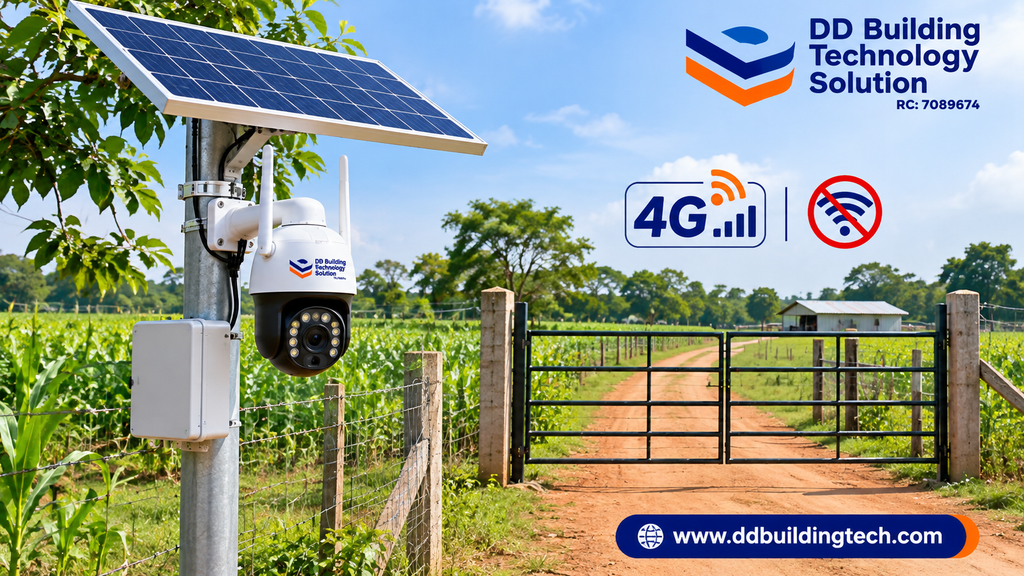
A 4G camera uses a mobile SIM card, like a phone, to send video over the mobile network. It doesn’t need your Wi-Fi or a router at all. Most are paired with a solar panel and a battery, so they don’t need a power point either. That’s the version people mean when they search for CCTV without Wi-Fi in Nigeria: a camera you can put somewhere with no power and no internet.
A wired system connects each camera to a recorder, called a DVR or NVR, with a cable. The recorder stores the footage on a hard drive and lets you watch it on your phone over the internet.
Each approach solves a different problem, which is why the question “which is best?” doesn’t have one answer.
Wired Systems: The Reliable Default
A wired system is still the backbone of most shop, office, and home CCTV in Nigeria, and for good reasons.
It records all the time, on its own hard drive. The recorder doesn’t need the internet to do its job. If your network goes down, or your data runs out, the cameras keep recording, and you review the footage later. For a shop or warehouse where you may need to look back over a day, that’s the feature that matters most.
It’s cheap per camera. On our current price list, a Hikvision 2MP camera is ₦13,500, a 4-channel Hikvision DVR is ₦50,000, and an 8-channel is ₦60,000. Compare that with the ₦65,000 to ₦150,000 you’d pay for a single solar or 4G camera, and the gap is obvious when you need several cameras in one place.
It has no monthly data cost. Remote viewing uses a little of your internet, but there’s no SIM to top up for each camera.
It’s proven. The technology is mature, spare parts are easy to find, and almost any CCTV technician in the country can work on it.
The limits are practical. Every camera needs a cable run back to the recorder, and the recorder needs mains power or an inverter. Long runs and awkward buildings add labour. And if the property you want to watch has no power at all, a wired system can’t help you.
Wi-Fi Cameras: Convenient, With Conditions
Wi-Fi cameras are popular because they’re simple. You plug one in, connect it to your network, scan a code with an app, and you’re watching. For a small home or a shop with good Wi-Fi, that’s attractive.
In our range, the simple Wi-Fi models start low: the V380 DOT Camera at ₦18,000, the CS-100 Bulb PTZ at ₦25,000, the CS-101 dual-lens bulb camera at ₦30,000, the CS-302 Owl HD at ₦30,000, and the Smart Wi-Fi V380 at ₦35,000. There are Wi-Fi solar versions too, such as the V380 Solar Dual Lens at ₦65,000 and the V380 Solar Triple Lens at ₦75,000.
The conditions are the part people skip. A Wi-Fi camera only works when three things are true at once: it has power, your router has power, and your internet is up. In a place with frequent outages, that’s a lot of moments when the camera is blind. Range matters too. A camera at the far end of a compound or on the outside wall of a shop may be at the edge of your Wi-Fi signal, and walls, metal roofing, and distance all weaken it. Many Wi-Fi cameras can record to a memory card, which helps during a network dropout, but a card holds far less than a recorder’s hard drive.
Wi-Fi cameras are a good fit for small indoor spaces: a living room, a shop counter, a nursery, a store room. They are a poor fit for the edges of a property.
4G Solar Cameras: For Places Nothing Else Reaches
A 4G solar camera is the answer for a property with no power and no internet. It has its own solar panel and battery, so no electrician is needed. It has a SIM card, so no router is needed. You can mount it on a pole at the far end of a farm, on a fence at a construction site, or at the gate of an estate with an unreliable supply.
This is where our 4G range sits. Current prices include:
| Model | Type | Price (₦) |
|---|---|---|
| TS-15 4G V380 Single Lens Solar PTZ | 4G solar PTZ | 80,000 |
| DS-20 4G V380 Dual Lens Solar PTZ | 4G solar PTZ | 80,000 |
| DS-85 4G Triple Lens V380 PTZ | 4G PTZ | 100,000 |
| 4G Single Lens V380 Solar PTZ | 4G solar PTZ | 100,000 |
| 4G Ubox 4MP Single Lens Solar Bullet Battery Camera | 4G solar bullet | 108,000 |
| TS-10 4G Ubox Single Lens PTZ Solar | 4G solar PTZ | 110,000 |
| DS-90 4G V380 Triple Lens Solar | 4G solar | 110,000 |
| DS-100 4G V380 Four Lens Solar | 4G solar | 110,000 |
| DS-35 4G Ubox Dual Lens PTZ Solar | 4G solar PTZ | 120,000 |
| ALS-15 4G V380 Single Lens Solar Light and Camera | Light and camera | 125,000 |
| ALS-60 4G V380 Triple View Solar Light and Camera | Light and camera | 135,000 |
| DS-40 4G Ubox Dual Lens PTZ Solar | 4G solar PTZ | 140,000 |
| DS 50 4G Ubox Triple Lens | 4G | 140,000 |
| ALS-10 4G Ubox Single Lens Solar Light and Camera | Light and camera | 150,000 |
| ALS-40 4G Ubox Dual Lens Solar Light and Camera | Light and camera | 150,000 |
Prices come from our current price list and move with the exchange rate. Ask us to confirm today’s price, stock, and the specifications of any model, including battery capacity and how it records, before you buy. Message us on WhatsApp.
“PTZ” means pan, tilt, and zoom: the camera can turn and zoom, which helps cover a wide area with one unit. “Dual lens” and “triple lens” models combine more than one lens in a single housing for a wider view. “Ubox” and “V380” are names of the apps and platforms the cameras use for viewing.
The Real Running Cost: Mobile Data
A 4G camera costs you nothing in electricity, but it uses mobile data, and how much depends almost entirely on how it records.
Streaming continuously over 4G is expensive and impractical. Recording on motion and sending only alerts and short clips is what makes a 4G camera affordable to run.
The practical advice is simple. Set the camera to motion recording. Use a memory card for local storage where the model supports it. Watch your data use in the app for the first week or two and adjust. And choose a data plan with a comfortable margin, because a camera that runs out of data stops reporting. Ask us about SIM and router options when you request a quote.
What Can Go Wrong With a 4G Solar Camera
Solar cameras are brilliant in the right place and frustrating in the wrong one. Three things decide which.
Signal. A 4G camera is only as good as the mobile coverage where it’s mounted. Before you buy, stand where the camera will go and check your phone’s signal on the network you plan to use. Bars at your gate don’t guarantee bars on top of a pole behind the house.
Sun. The panel needs unshaded sun for most of the day. Trees, walls, and roof edges that shade it will starve the battery over a few cloudy days. In Enugu, a location-based solar analysis puts the lowest seasonal output at around 4.8 kWh per day for each kilowatt of panels, which is decent, but a shaded panel on a small camera loses a large share of that.
Theft. A camera with a panel and battery on a pole is a visible target in some areas. Mount it high, use anti-theft fasteners, and put it where another camera, a guard, or a neighbour can see it.
Also remember that a solar camera is built to run lightly. It isn’t designed to record high-definition video all night on a small battery. It wakes up when something moves, records a clip, and goes back to sleep. For most gates, fences, and perimeters, that is exactly what you want.
Side by Side: How the Three Compare
| Wired (DVR) | Wi-Fi camera | 4G solar camera | |
|---|---|---|---|
| Needs mains power | Yes | Yes | No |
| Needs internet or Wi-Fi | Only for remote viewing | Yes | No, uses a SIM |
| Records without internet | Yes, to the DVR’s hard drive | Only to a memory card | To a memory card, with alerts over 4G |
| Typical cost per camera | Lowest | Low to moderate | Highest |
| Running cost | Very low | Very low | Mobile data |
| Best for | Shops, offices, homes, warehouses | Small indoor spaces | Farms, gates, remote sites, yards |
| Main weakness | Cable runs and power cuts | Depends on router, power and range | Signal, sun and theft |
Which Property Suits Which
Here is how we’d answer the wireless CCTV camera Nigeria question for each kind of property.
A home or compound in town with mains power and an inverter. A wired system, with perhaps one Wi-Fi camera for a hard-to-reach indoor spot. It’s the cheapest way to cover several areas, and it keeps recording whatever the internet does.
A shop or small office. Wired. You need continuous recording for disputes and cash handling, and you probably want several cameras. Our guide to the best CCTV cameras for shops and warehouses covers the layout and the equipment in more detail.
An estate gate or perimeter. A mix. Wired cameras at the gatehouse, where there’s power, and 4G solar cameras along the perimeter and at far entrances. Lighting makes all of it more useful at night, so see our guide to solar street lights for estates.
A farm, plot of land, or building site. 4G solar. With no power and no internet, it’s often the only practical option. Add a second camera so each one can see the other’s mounting point.
A warehouse with a large yard. Wired inside, where the recorder lives, and 4G solar PTZ cameras for the open yard and far boundary, where running cable would cost more than the camera.
A rented property where you can’t drill or run cables. A Wi-Fi camera for indoors. It’s temporary, but sometimes that’s what the lease allows.
What It Costs: Three Realistic Setups
A wired shop, four cameras. Four Hikvision 2MP cameras at ₦13,500 each (₦54,000), a 4-channel DVR at ₦50,000, a 4-way power supply box at ₦15,000, a 500GB hard drive at ₦18,000, and a 100-metre roll of RG59 cable at ₦24,500 come to ₦161,500 in equipment, before installation. It’s the cheapest way to get four cameras recording all day. Our CCTV installation cost guide shows what installed totals look like.
Four Wi-Fi cameras. Four Smart Wi-Fi V380 cameras at ₦35,000 each are ₦140,000, plus a good router and memory cards. The sticker price is close to the wired shop, but you’ll depend on your Wi-Fi and have far less storage.
Two 4G solar PTZ cameras for a plot or yard. Two DS-20 units at ₦80,000 each are ₦160,000, plus SIM and data. It’s the most expensive per camera, and it’s also the only option that works where there’s no power or internet.
Each is the cheapest suitable choice for a different property, which is why price alone should never decide it.
A Hybrid Often Works Best
You don’t have to choose one type for the whole property. Many of the best installations combine them: a wired recorder covering the buildings, with 4G solar cameras extending coverage to places cables can’t reach. The recorder gives you continuous, reliable footage where it matters most. The solar cameras fill in the gaps and send an alert when something moves at the edge. In other words, the best wireless CCTV camera setup in Nigeria is often part wired and part wireless.
Mistakes to Avoid
Buying a solar camera for a spot with no signal. Check coverage first on the network you intend to use.
Expecting 24/7 live HD from a battery camera. It’s designed to record on motion, not to stream all night.
Mounting the panel in the shade. It will charge poorly and fail after a few overcast days.
Choosing Wi-Fi for the edge of the property. Range drops quickly, and the connection becomes unreliable.
Ignoring storage. Wired systems need a hard drive big enough for the days you want to keep. Wireless cameras need a memory card. Without storage, there’s nothing to review.
Leaving the default password. Change it on every camera and recorder at installation. A camera with a default login is an open door.
Not planning for power cuts. A DVR needs steady power. Run it on an inverter or solar so it doesn’t go dark in an outage. If you’re sizing that, our guide to sizing a solar system for a shop shows how much a small CCTV system draws.
Not sure which type fits your property? Chat with DD Building Tech on WhatsApp with a description of the place, whether it has power and internet, and how many areas you want to cover. We’ll recommend a setup and give you a price.
Frequently Asked Questions
What is the best wireless CCTV camera in Nigeria?
It depends on where it’s going. For a spot with no power or internet, a 4G solar camera is the right choice. For a small indoor space with good Wi-Fi, a Wi-Fi camera is enough. For a shop or office with several areas to cover, a wired system is usually the better value.
Do 4G solar CCTV cameras work without Wi-Fi?
Yes. A 4G camera uses a mobile SIM card to send video and alerts, so it doesn’t need Wi-Fi or a router. It needs mobile signal at the mounting point and enough data in the plan.
How much data does a 4G CCTV camera use?
It varies widely with how it records. Estimates for light, motion-triggered use run from roughly 1 to 20 GB a month, with lower figures for motion-only recording on newer compression. Continuous streaming uses far more, which is why motion recording is the usual setting.
Do solar CCTV cameras work on cloudy days?
They keep working on the battery and recharge more slowly. A panel in open sun with a healthy battery copes with normal cloudy spells. Shade or a long run of overcast days is what causes problems.
Is wired CCTV better than wireless?
For continuous recording and the lowest cost per camera, yes. For places without power or internet, a wireless 4G solar camera is better because a wired system simply can’t be installed there.
Can I mix wired and wireless cameras?
Yes, and it’s often the best approach. A wired recorder covers the main buildings and 4G solar cameras cover remote areas.
Do you install wireless and solar cameras?
Yes. We supply and install wired systems, Wi-Fi cameras, and 4G solar cameras. Our CCTV installation service includes checking signal and sun at each mounting point.
Choose the Camera That Fits the Property
Whichever wireless CCTV camera Nigeria option you lean towards, the right choice comes from your property, not from the box. Tell us where the cameras will go and what you need to see, and we’ll match the type to each location.
Get a CCTV installation quote →
We install in Enugu and Anambra, with nationwide delivery everywhere else in Nigeria. If you’d like to know whether you’re legally expected to have cameras at all, read our guide: Is CCTV mandatory for businesses in Nigeria?