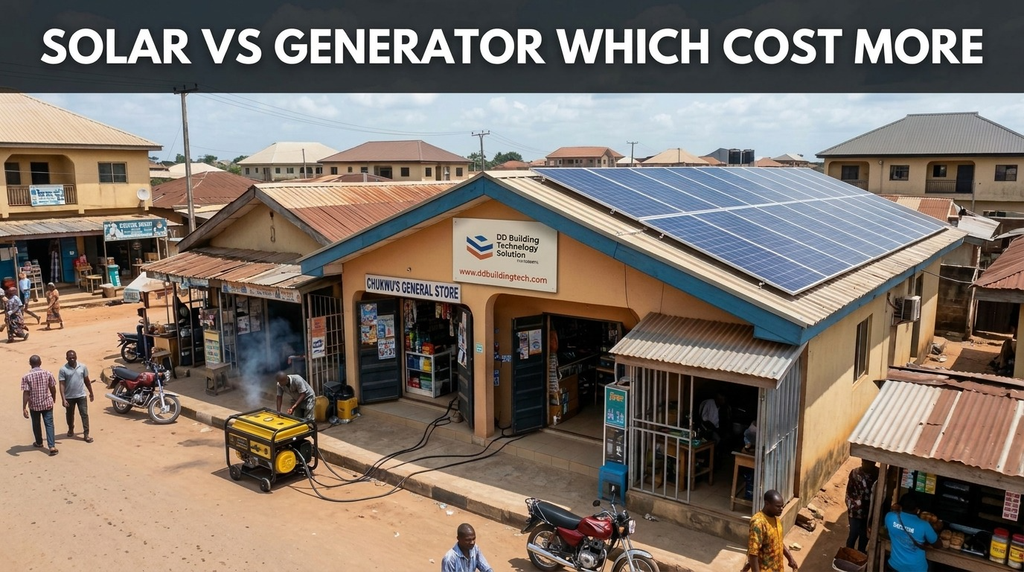
Most Nigerians who run a generator never sit down to calculate what it costs. The spend is spread across tiny purchases, a few litres here and a jerrycan there, and it disappears into the week without ever showing up as one number. That’s exactly why it’s so easy to underestimate.
This guide puts a number on it. We’ll work out what a petrol generator costs per hour at today’s fuel price, what that adds up to over a month, a year and a decade, and then compare it with the real cost of a solar system, using the 5KVA builds from our 5KVA solar system cost guide. If the solar vs generator Nigeria debate has left you undecided, the numbers below should settle it, and they’ll also show you the cases where the generator still makes sense.
First, Today’s Fuel Price (It Moves Faster Than You Think)
On 1 October 2026, NNPC retail stations were selling petrol at between ₦1,360 and ₦1,370 per litre in Lagos and Abuja, according to Legit.ng’s report on the Independence Day discount. Back in mid-July, the same retailer had cut its price to ₦1,110. That’s a swing of more than ₦250 per litre in under three months.
For the worked examples below, we’ll use ₦1,370 per litre. If you pay less, scale the numbers down. If fuel keeps climbing, the generator side only gets worse. Either way, the volatility is part of the story: a generator ties your household budget to a price you don’t control.
What a Petrol Generator Actually Costs Per Hour
How much fuel a generator burns depends on its size and how hard you push it. Spec sheets for 3KVA petrol generators typically quote somewhere between 0.7 and 1.2 litres per hour at three-quarter load. One 3KVA unit lists 0.72 litres per hour at 75 percent load, while another lists 1.2. Cheaper, older, or heavily loaded units can burn more.
We’ll use 0.8 litres per hour for a typical home or shop load. That’s a mid-range, deliberately unexaggerated figure.
At ₦1,370 per litre, that’s ₦1,096 for every hour the generator runs. It works out to roughly ₦800 to ₦900 per kilowatt-hour once you account for how inefficient a small generator is at light loads. For comparison, Band A grid power costs between ₦160 and ₦225 per kWh depending on your state, as we explain in our guide to reducing your electricity bill after the Band A hike. Generator electricity costs roughly four to five times as much as Band A grid power, which is already the most expensive grid electricity you can buy.
What That Adds Up To
Here is the fuel bill alone, for three realistic patterns of generator use:
| Generator use | Per day | Per month | Per year |
|---|---|---|---|
| 4 hours a day (evenings only) | ₦4,384 | ₦131,520 | ₦1,578,240 |
| 8 hours a day (long outages) | ₦8,768 | ₦263,040 | ₦3,156,480 |
| 12 hours a day (heavy dependence) | ₦13,152 | ₦394,560 | ₦4,734,720 |
Assumes a 3KVA petrol generator burning 0.8 litres per hour at ₦1,370 per litre. Your use will differ, so substitute your own hours and fuel price.
A shop that runs a generator through trading hours, or a home in a Band D or E area that gets only a few hours of grid supply, can easily sit in the eight-hour row. That’s more than ₦3 million a year on fuel before anything else.
The Costs That Aren’t in That Table
The fuel figure is the visible part. A few other costs sit behind it.
Servicing. Small petrol generators need regular oil changes, commonly every 50 to 100 running hours depending on the model, plus spark plugs, air filters and eventual carburettor and engine repairs. Run one eight hours a day, and you’re changing oil every week or two.
Replacement. Generators that run daily don’t last as long as ones kept for emergencies. Over a ten-year period, most households end up buying at least one replacement.
Downtime and lost trade. Generators fail, fuel runs out, and queues form during scarcity. For a shop, every hour of dead power is lost sales that never show up on the fuel receipt.
Noise. Neighbours, customers, and your own family live with it every day.
Safety. This one deserves its own paragraph. Generator exhaust contains carbon monoxide, which you can’t see or smell and which can kill within minutes in an enclosed space. The US Consumer Product Safety Commission’s portable generator safety alert is blunt: never run a generator indoors, including garages and sheds, even with doors or windows open, and keep it far from windows and vents. Generator-fume deaths are reported in Nigeria far too often, almost always because the generator was running in an enclosed or partly enclosed space. Solar produces no exhaust at all.
None of these figures appear in our table, which means the true cost of running a generator is higher than what we’ve shown.
What Solar Costs, in the Same Terms
From our 5KVA guide, the two complete, installed builds look like this, using current prices from our stock:
| Build | Estimated installed cost |
|---|---|
| 5KVA solar system with lithium battery bank (10kWh) | ₦4,150,000 – ₦4,350,000 |
| 5KVA solar system with tubular battery bank | ₦2,790,000 – ₦2,940,000 |
We’ll use midpoints of about ₦4.25 million and ₦2.87 million. The array is six 600-watt panels, which in Nigerian conditions produce somewhere around 12 kWh a day after losses. That’s a planning estimate, not a promise.
How Long Until Solar Pays for Itself?
Divide the system cost by the monthly fuel you stop buying, and you get the payback time. This assumes solar replaces all of your generator running hours:
| Generator use | Fuel saved per month | Payback, lithium build | Payback, tubular build |
|---|---|---|---|
| 4 hours a day | ₦131,520 | about 32 months | about 22 months |
| 8 hours a day | ₦263,040 | about 16 months | about 11 months |
| 12 hours a day | ₦394,560 | about 11 months | about 7 months |
Two honest adjustments. First, solar won’t replace 100 percent of generator hours. A run of heavy-cloud days may need a backup. If solar covers around 80 percent of your hours, add roughly a quarter to each payback time. Second, fuel prices matter. At July’s ₦1,110 per litre, the eight-hour payback for the lithium build stretches from about 16 months to about 20.
Also worth noting: the 5KVA system can carry more load than a 3KVA generator, so this isn’t a perfectly like-for-like comparison. If your actual needs are smaller, a smaller, cheaper solar system will pay back faster still.
The Ten-Year View
Payback tells you when solar breaks even. The ten-year view shows what happens after. The table below compares fuel only for a generator against the full cost of solar, including battery replacements for the tubular build (three replacements at today’s ₦1,040,000 each, as we explain in our lithium vs tubular battery comparison):
| Over 10 years | Cost |
|---|---|
| Generator fuel, 4 hours a day | ₦15,782,400 |
| Generator fuel, 8 hours a day | ₦31,564,800 |
| Generator fuel, 12 hours a day | ₦47,347,200 |
| 5KVA solar, lithium build | about ₦4,250,000 |
| 5KVA solar, tubular build (with 3 battery replacements) | about ₦5,985,000 |
Generator figures use today’s fuel price held flat for ten years and exclude servicing, spare parts, and replacement units, so they understate the real cost. Solar figures exclude panel cleaning and a possible inverter replacement near the end of the period.
Spread across the energy produced, solar works out to roughly ₦100 to ₦140 per kWh over ten years (about ₦97 for the lithium build and ₦137 for the tubular build, using 12 kWh a day). A generator, as we saw, is around ₦800 to ₦900. Even Band A grid power at ₦225 is cheaper than the generator, and solar is cheaper than that. On cost alone, the solar vs generator Nigeria question isn’t close over a decade.
What a Generator Does to a Shop’s Trading Day
For a home, a generator is mostly a cost and a nuisance. For a shop, it’s part of how the business runs, and that changes the calculation. A customer standing at a counter doesn’t wait while you find the jerrycan, refuel, and restart. A fridge full of cold drinks doesn’t forgive a long gap between the grid going and the generator coming on. A POS terminal that drops mid-transaction costs you the sale and sometimes the customer.
Solar with a battery bank and a hybrid inverter removes the gap. The switch from solar to battery to grid happens in a fraction of a second, so lights stay on, the fridge keeps its temperature, and the POS never notices. The quiet is a benefit people don’t expect: customers can hear each other, and so can you.
If you run a small business, add one more line to your own calculation: the sales you lose or the stock you spoil when power drops. That figure rarely appears on any receipt, but it can be larger than the fuel bill.
Sizing Solar to Replace Your Generator, Not the Other Way Round
A common mistake is to size a solar system by copying the generator’s rating. A 3KVA generator becomes a 3KVA inverter, and the buyer wonders why the system struggles. The two machines aren’t comparable that way. A generator only has to produce power while it’s running, and you decide when to start it. A solar system has to produce power in the daytime, store enough of it for the evening, and cope with whatever you switch on at any moment.
The better approach is to start from what you actually use. List the appliances you run on the generator, note their wattage and the hours each one runs, and total up the daily energy in kilowatt-hours. That number decides the battery size. Then note the highest load that could run at one time, including motor start-up surges, which decides the inverter size. Finally, the daily energy decides how many panels you need to refill the battery by evening.
That sequence is the opposite of how most people shop, which is why so many first systems end up undersized. Our Solar Installation service starts with exactly this load assessment, and it costs nothing, because the system only works if it’s designed around your real usage. If your generator has been the only thing keeping your business open, bring us the fuel receipts as well. They tell us more about your actual load than any appliance label.
When the Generator Still Makes Sense
We sell and install solar for a living, and we’ll still tell you when it isn’t the right call in the solar vs generator Nigeria debate.
You only need power occasionally. If you run a generator for an hour or two a few days a week, the fuel bill is small enough that solar takes a very long time to pay back.
You’re renting or moving soon. Solar is an investment in a specific property. If you won’t be there for several years, the maths changes.
You have very heavy, occasional loads. Welding machines and large motors can demand more surge power than a home inverter is sized for. A generator, or a larger and more expensive solar system, may be the practical answer.
You can’t raise the upfront cost right now. A generator costs far less to buy. If cash is the real constraint, that’s a legitimate reason to start there, though a phased solar plan, which we cover in the 5KVA guide, is worth discussing before you commit to years of fuel spending.
The Best of Both: Solar With a Generator as Backup
You don’t have to choose one for good. Many of our customers install solar for everyday use and keep a smaller generator for long cloudy stretches or exceptional loads. Many hybrid inverters can take a generator as an input alongside the grid, so the machine switches to it automatically when solar and battery run low. We explain how that switching works in our guide to hybrid vs pure sine wave inverters.
The result is a generator that runs a few days a year instead of every day, which cuts the fuel bill, the servicing, and the noise by most of what they were.
What About a Portable Solar Generator?
For small needs, a portable solar power station, sometimes called a solar generator, is a simpler alternative. These are self-contained batteries with a built-in inverter that charge from the sun or the wall. They suit phones, laptops, lights, a TV, a router, and short backup for a small shop. They don’t replace a home solar system, because they can’t run heavy loads like an air conditioner or a pumping machine. Our Solar Generators page shows the current Cola range, and it’s a sensible way to cut fuel use if a full installation isn’t yet in reach.
Work Out Your Own Number in Two Minutes
You don’t need a spreadsheet. Take three numbers:
- Litres your generator burns per hour (check the manual, or note how long a litre lasts)
- The petrol price you pay today
- The hours you run it each day
Multiply them together for a daily cost, and multiply by 30 for a month. Then compare that monthly figure with the system costs above. If your monthly fuel spend is above about ₦130,000, solar is likely to pay for itself inside three years. If it’s above ₦260,000, you’re likely looking at around a year and a half or less.
Want your own payback worked out? Chat with DD Building Tech on WhatsApp with your generator size, daily hours, and what you run. We’ll size a system and give you a payback figure based on your numbers, not ours.
Frequently Asked Questions
Is solar cheaper than a generator in Nigeria?
Over any meaningful period, yes. At today’s fuel prices, a petrol generator costs roughly ₦800 to ₦900 per kWh to run, while a solar system works out at about ₦100 to ₦140 per kWh over ten years. Solar costs more upfront but far less to run.
How much does it cost to run a generator in Nigeria per month?
For a 3KVA petrol generator at ₦1,370 per litre, using about 0.8 litres an hour, fuel alone is roughly ₦131,000 a month at four hours a day and ₦263,000 a month at eight hours, before servicing and repairs.
How long does it take for solar to pay for itself compared with a generator?
If solar replaces eight hours of daily generator use, the lithium build pays back in roughly 16 months and the tubular build in about 11. If you run the generator less, it takes longer.
Can solar completely replace a generator?
For most homes and shops, it can replace daily use. Some customers keep a small generator as a backup for long cloudy periods or very heavy loads.
Is a solar generator the same as a solar system?
No. A portable solar generator is a self-contained power station for light loads. A solar system with panels, an inverter, and a battery bank is built to run a whole home or shop.
Is it safe to run a generator at night?
Only outdoors, far from windows, doors, and vents. Never run one indoors or in a garage, even with ventilation, because carbon monoxide can build up and kill within minutes.
Stop Paying for Fuel Every Month
Settle your own solar vs generator Nigeria question with real numbers: tell us what you run and how long your generator is on each day. DD Building Tech will design a solar system around your real load, show you the payback in plain numbers, and install it properly.
Get a free load assessment & quote →
We install across Enugu and Anambra, with nationwide delivery everywhere else in Nigeria.